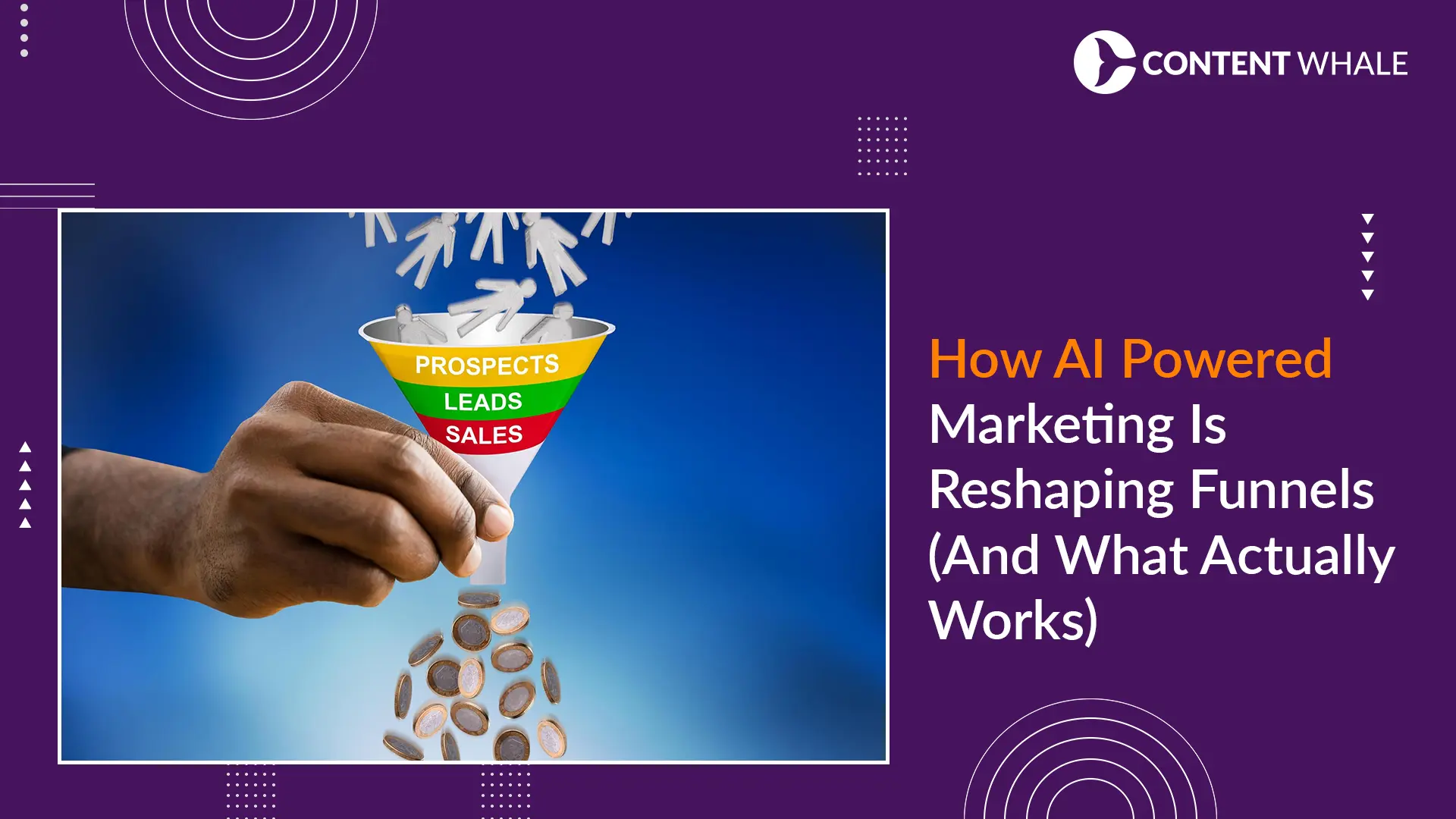
AI powered marketing works best when it enhances existing funnel structures rather than replacing them entirely. Companies using AI for marketing see measurable improvements in personalization (up to 40% higher engagement), lead scoring accuracy, and content efficiency.
However, the core marketing funnel framework remains unchanged. AI powered marketing handles data processing, pattern recognition, and repetitive tasks while humans drive strategy, creative direction, and quality control.
The key is knowing which stages benefit most from automation and which require human judgment.
This guide breaks down what actually works in AI powered digital marketing funnels based on independent research and real implementation data.
AI’s Real Impact on Customer Behavior
Consumer research patterns have shifted significantly since AI powered marketing tools entered mainstream use. Search behavior data shows 46% of consumers now use AI-powered tools for product research before making purchase decisions (Source). This change affects how information flows through marketing funnels at every stage.
Generative search tools provide direct answers before users click through to websites. Traditional SEO strategies focused on driving traffic to landing pages, but digital marketing powered by AI must now optimize for answer engines that extract and synthesize information automatically.
The University of Pennsylvania’s research on consumer decision-making found that AI recommendation systems influence 35% of purchase decisions on platforms where they’re deployed (Source).
Click-through behavior has changed as well. Users spend less time comparing multiple sources when AI powered marketing tools aggregate information for them. This compression of the research phase means marketing content must deliver value faster and more directly. Decision timelines have shortened in categories where AI for marketing provides instant product comparisons and feature analysis.
The shift isn’t universal across all industries. High-consideration purchases (B2B services, healthcare, financial products) still involve human research and multiple touchpoints. Digital marketing must account for these variations rather than applying one-size-fits-all automation.
Where AI Actually Delivers Results Across Funnel Stages

Awareness Stage Applications
Content production efficiency represents the clearest AI powered marketing advantage at the top of the funnel. Research from MIT’s Computer Science and Artificial Intelligence Laboratory documented 55% faster content creation when writers used AI-assisted tools compared to manual processes.
AI powered tools excel at:
- Topic research and trend identification across multiple data sources
- Audience persona development based on behavioral data patterns
- Content structure optimization for search intent matching
- Initial draft generation that humans refine and fact-check
The quality gap between AI-generated and human-created content has narrowed for informational content. However, strategic positioning, brand voice consistency, and persuasive messaging still require human oversight. AI tools accelerate production but don’t replace editorial judgment or subject matter expertise.
Audience targeting accuracy improves when machine learning analyzes engagement patterns across channels. Stanford University research on predictive modeling found AI systems achieved 73% accuracy in identifying high-intent audiences compared to 51% for rule-based targeting (Source).
Consideration and Comparison Stage
Personalization engines create the strongest performance lift in the middle funnel. A study published in the Journal of Marketing Research showed personalized content recommendations increased engagement rates by 41% compared to static content paths. (Source)
AI powered systems analyze:
- Previous interaction history and content consumption patterns
- Behavioral signals indicating purchase intent level
- Optimal timing for follow-up based on individual user patterns
- Content format preferences (video, text, interactive tools)
Lead scoring accuracy improves when AI for marketing processes multiple data points simultaneously. Traditional lead scoring used simple point systems based on demographics and basic actions. Machine learning models in AI powered marketing incorporate hundreds of behavioral signals to predict conversion likelihood more accurately.
Dynamic content adaptation represents another middle-funnel advantage. These systems can test and adjust messaging, offers, and content sequencing based on real-time response data. This creates personalized experiences at scale without manual segmentation work.
Conversion and Retention
Predictive analytics at the conversion stage help identify optimal timing and messaging combinations. Research from Carnegie Mellon University’s Heinz College found that AI-optimized send times improved email conversion rates by 23% compared to standard scheduling.
Automated nurture sequences in AI marketing adjust based on engagement signals. If a prospect opens emails but doesn’t click, the system can automatically shift to different content types or offers. This behavioral responsiveness requires less manual campaign management while maintaining personalization.
Churn prediction models analyze usage patterns, support interactions, and engagement drops to identify at-risk customers. AI for marketing can trigger retention campaigns before customers actively consider leaving. The accuracy of these predictions depends heavily on data quality and volume available to AI powered marketing systems.
What Doesn’t Need AI Overhaul
Core marketing funnel frameworks remain valid despite AI powered marketing adoption. Research from the Harvard Business School found that 78% of marketing organizations still structure campaigns around traditional awareness-consideration-conversion models enhanced with AI powered tools rather than completely new frameworks (Source).
Strategic decisions that don’t benefit from AI automation:
- Brand positioning and differentiation strategy
- Creative direction and campaign concepts
- Ethical considerations in targeting and messaging
- Budget allocation across channels and initiatives
Human judgment outperforms AI marketing in situations requiring:
- Cultural context and sensitivity evaluation
- Crisis response and reputation management
- Strategic pivots based on market changes
- Long-term vision setting beyond data patterns
AI powered marketing works within existing strategic frameworks rather than replacing them. The fundamental goal of moving prospects through awareness to purchase hasn’t changed. The tools for executing that strategy have improved through AI for marketing, but the underlying marketing principles remain constant.
Complete funnel rebuilds waste resources and create unnecessary disruption. Organizations see better results from targeted AI powered marketing integration at specific high-impact points rather than wholesale process replacement.
Building AI Workflows That Work

Structured Process Over Random Tools
Successful AI digital marketing requires workflow mapping before tool selection. Organizations that document current processes first achieve 60% faster AI powered marketing implementation compared to those who adopt tools reactively, according to MIT Sloan Management Review research (Source).
Implementation steps:
- Map existing workflows and identify bottlenecks or manual tasks
- Define specific outcomes AI powered marketing should improve (speed, accuracy, scale)
- Evaluate integration requirements with current marketing technology
- Establish data quality standards and governance protocols
- Create training programs for team members using AI powered marketing systems
Platform integration creates significant challenges. AI powered marketing tools must connect with CRM systems, content management platforms, analytics tools, and advertising channels. Poor integration leads to data silos that reduce AI for marketing effectiveness.
Team roles shift from manual execution to AI powered marketing supervision and quality control. Marketing professionals need training in prompt engineering, output evaluation, and system optimization. The skills required change but the need for marketing expertise increases rather than decreases.
Human Oversight Requirements
Quality control checkpoints prevent AI powered marketing errors from reaching customers. Every AI output should pass through human review for:
- Factual accuracy and source verification
- Brand voice and tone consistency
- Compliance with legal and regulatory requirements
- Cultural appropriateness and sensitivity
- Strategic alignment with campaign goals
Strategic decision points that require human judgment include offer development, campaign timing around external events, competitive response strategies, and partnership opportunities. AI powered digital marketing provides data analysis and recommendations, but humans make final strategic calls.
Performance monitoring must track both system accuracy and business outcomes. Systems can optimize for the wrong metrics if success criteria aren’t properly defined. Regular audits ensure AI for marketing recommendations align with actual business priorities.
Performance Reality Check
Realistic performance expectations differ significantly from vendor marketing claims. A comprehensive review of AI marketing implementations published in the International Journal of Research in Marketing found actual performance improvements averaged 18-25% across metrics, substantially lower than the 50-200% improvements often claimed (Source).
Variables affecting AI powered digital marketing impact:
- Data volume and quality available for training models
- Industry complexity and purchase cycle length
- Team expertise in AI powered marketing tool usage and optimization
- Integration quality with existing technology infrastructure
Common implementation mistakes include expecting immediate results without optimization time, applying AI for marketing to every process regardless of fit, neglecting data quality issues that reduce accuracy, and failing to train teams on proper AI powered marketing usage.
ROI timelines for AI powered marketing investments typically span 6-12 months for measurable revenue impact. Initial efficiency gains appear within 3-6 months as teams learn AI powered digital marketing systems and workflows stabilize. Long-term value compounds as AI powered marketing models improve with more data and usage patterns become clear.
Getting Started Without Overhauling Everything
Pilot programs in high-impact areas reduce risk and demonstrate value before full deployment. Start with processes where:
- Data availability is strong and clean
- Current performance has clear measurement
- Improvements would create significant time or cost savings
- Failure wouldn’t damage customer relationships
Measurement frameworks should track both efficiency metrics (time saved, cost reduction) and effectiveness metrics (conversion rates, engagement improvements). Compare performance against baseline data from manual processes.
Scaling decisions should follow evidence from pilot results. Expand AI for marketing to similar use cases first rather than jumping to completely different applications. This builds team expertise gradually and reduces implementation risk.
Resource allocation should prioritize the clearest ROI path. Content generation, lead scoring, and email optimization typically show faster returns than experimental applications like chatbots or voice search optimization.
Conclusion
AI powered marketing delivers the strongest results when applied strategically to specific funnel stages rather than implemented everywhere at once. Focus on areas where data processing and personalization create measurable impact: content generation, lead scoring, and behavioral prediction.
Maintain human control over strategy, brand messaging, and creative decisions. Start with pilot programs in high-impact areas, measure AI powered digital marketing results rigorously, and scale based on performance data.
Success requires structured workflows, team training, and realistic expectations about ROI timelines. Ready to build an AI-powered content strategy that drives real results? Partner with Content Whale for data-backed marketing content that converts.
FAQs
Q1: What is AI powered marketing?
AI powered marketing uses machine learning and automation to analyze customer data, personalize content, predict behavior, and optimize campaigns. It enhances human decision-making rather than replacing marketing strategy or creative work entirely.
Q2: Which funnel stages benefit most from AI for marketing?
Lead scoring, content personalization, and behavioral prediction deliver the strongest ROI. AI powered digital marketing excels at processing large datasets and identifying patterns that humans miss, particularly in consideration and conversion stages.
Q3: Do I need to rebuild my entire marketing funnel for AI?
No. Core funnel frameworks (TOFU/MOFU/BOFU) remain valid. AI powered marketing enhances existing processes through automation and personalization. Focus on integrating AI for marketing into specific high-impact areas rather than complete overhauls.
Q4: What results can I expect from AI marketing?
Realistic improvements include 15-40% higher engagement from personalization, faster content production, and improved lead qualification accuracy. Results vary significantly based on implementation quality, industry, and data availability.
Q5: How long before AI for marketing shows ROI?
Most businesses see initial efficiency gains within 3-6 months. Measurable revenue impact typically requires 6-12 months as marketing systems learn patterns, teams develop workflows, and optimization cycles complete. Start with pilot programs first.