



 BFSI
 HealthCare
 Edtech
 SaaS
 Automobile
 Travel
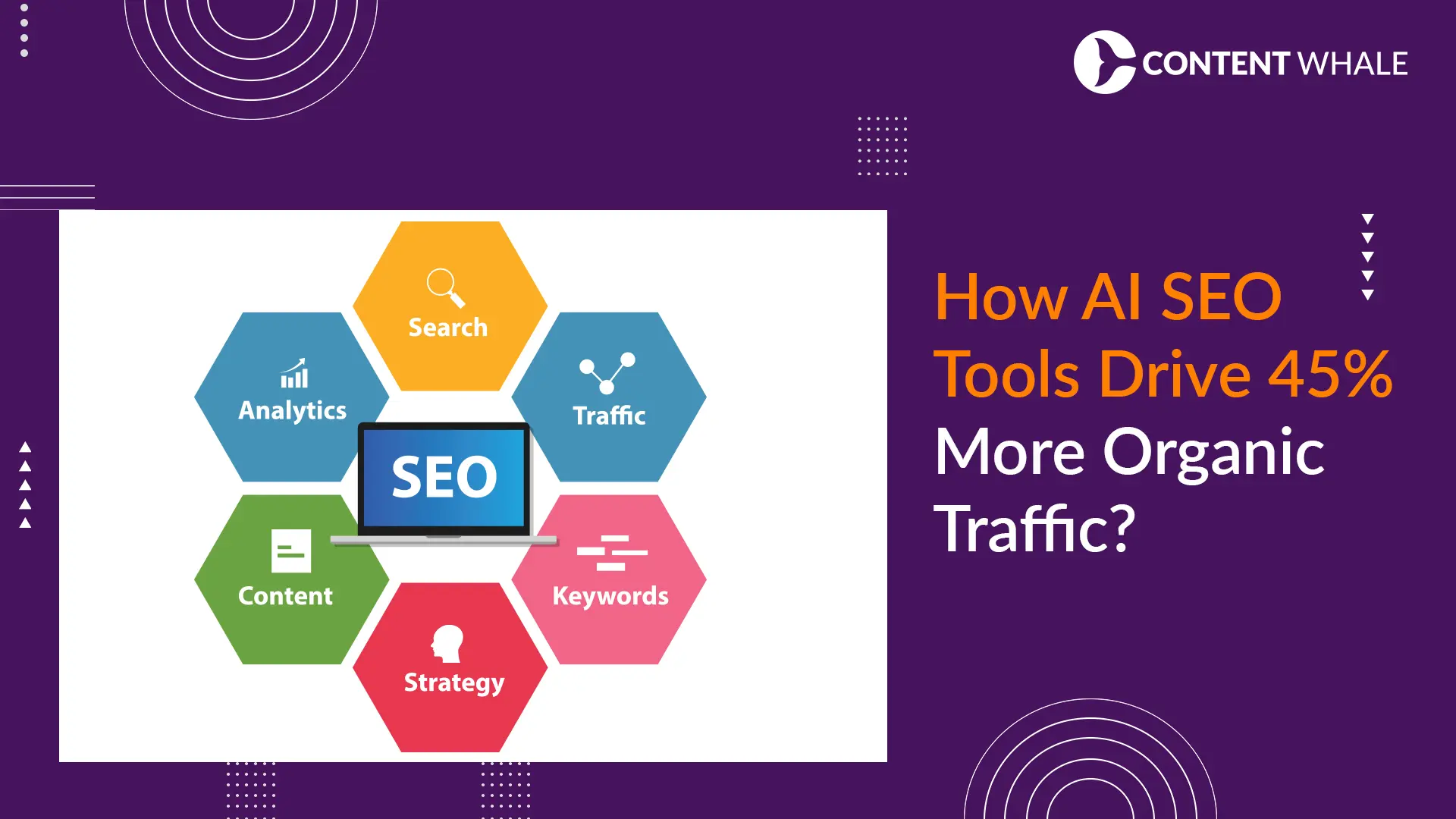
AI-driven SEO software speeds up keyword research, content briefs, optimization and monitoring, but it does not replace a strategy or an editor. Pick one tool for one job, test it on ten pages, and judge it by clicks, rankings and conversions.
Search results are evolving. In an analysis of 68,879 Google searches performed by 900 American adults in March 2025, people clicked on the traditional search result on 8% of occasions where an AI overview was visible, compared to 15% of those where there was no AI summary (Source).
There are no extra criteria or optimization needed to be featured in Google AI Overviews or AI Mode (Source), so the tools can assist in the basics but not in the secret sauce.
This guide explains why AI-driven SEO software matters, which five tools to compare, how AI search optimization tools increase organic traffic, how to roll them out and how to measure the result.
Why AI-Driven SEO Software Matters?

A) Speed and Efficiency
Speed is the priority. Artificial Intelligence (AI) SEO software can group keywords, write briefs, identify gaps in content and grade pages within minutes. In the Content Marketing Institute’s 2026 survey of B2B marketing professionals, 41% reported using AI SEO software. Spend the freed-up time on editing and strategy.
B) Data-Driven Decisions
Audits, rank tracking and SERP analysis show which pages to fix first, which queries to target and which competitors to study. A good AI-driven SEO software dashboard replaces guesswork with a ranked task list.
C) Conversion Focus
As per Semrush 2025 study about over 500 topics related to digital marketing and SEO, a visitor from the AI search engine is four-and-a-half times more valuable than a traditional organic visitor in terms of conversion rate (Source).
However, it is an extrapolation and no visitor number is revealed behind the above ratio. So, it is better to measure your own conversion first.
Top AI SEO Tools to Compare
Generative AI SEO software drafts text and briefs, and AI-driven SEO software as a category also covers audits, tracking and topic planning, so the table below lists five widely used tools with what each vendor states it does.
| Tool | What the vendor says it does | Best for |
|---|---|---|
| Surfer | Content Editor with real-time guidelines and content score, AI visibility tracking, content audit and a topical map (beta) | Writing and updating pages against live SERP data |
| Semrush | SEO, AI Visibility, Content, Local and Advertising toolkits, Site Audit and a free AI Visibility Checker | One platform for SEO and AI search tracking |
| Clearscope | Discover, Write, Optimize, Protect, Localize, Linking and Expand features for content planning, optimization and monitoring | Editorial teams that optimize and monitor content |
| Frase | Research that ends in a brief, content optimization, AI Agent drafting, GEO optimization and AI visibility | Briefs and optimization for smaller teams |
| MarketMuse | Content inventory, topic clusters, competitive content analysis, content briefs and personalized difficulty | Planning topics across a large site |
Features change often. Check each vendor’s site for current features and pricing before you buy, then run a trial on ten real pages and keep the tool that improves your own numbers.

How AI Search Optimization Tools Increase Organic Traffic?
SEO traffic software works when it feeds a plan with a goal, an owner and a deadline. Most AI SEO organic traffic gains come from four jobs.
A) Better Intent Matching
Tools compare your page with the pages that rank and show the subtopics, questions and terms that you miss. Add what readers need, and skip filler that only raises a score.
B) Technical SEO Fixes
Begin with indexing. Audit reports broken links, chain redirects, missing metadata, and slow-loading pages. Google states that the page must be indexed by Search and displayed in search results with a snippet before it is featured in Google’s AI capabilities.
C) Competitive Gap Analysis
Gap reports list the topics that competitors cover and you do not. Rank the gaps by search demand and by fit with your product, and write the top five first.
D) AI Visibility Tracking
Newer AI SEO tools for organic traffic also track whether ChatGPT, Gemini and Google’s AI features mention your brand. Our Jidoka case study reports GA4 organic users rising from 466 in August 2025 to 1,736 in February 2026, an increase of 272%, and 105 appearances in AI-generated answers with 261 pages cited.
The figures are self-reported. The page gives no measurement method or date for the AI appearances, and its headline visit count differs from the body figure, so read the case as an example of a content-first plan and not as a benchmark for any tool.
How to Implement AI-Driven SEO Software?

A) Start With Clear Goals
State one objective per tool, for example, to increase organic conversion rates of ten product pages by 25 percent within 90 days, and consider it an illustrative example of the format, not a benchmark. Take note of the initial figures before making any changes. Baselines matter.
B) Choose the Right Tool Stack
Match each tool to one job: planning, writing, auditing or tracking. Two tools that overlap double the cost and the confusion, so drop one.
C) Set Guardrails for AI Content
A study by Ahrefs examined 900,000 new pages written in English in April 2025 and found that 74.2% of those pages had AI-written content and 25.8% were human-only. The spam policies of Google consider using generative AI technology to create multiple pages without adding any value to be scaled content abuse. Each draft must be reviewed by a designated editor.
D) Train Your Team and Get Support
Teach writers to treat AI-driven SEO software scores as hints and not as rules, and teach editors to reject filler. If you want a team to run answer engine and generative engine work, our AI SEO services cover query research, structured content, editorial review and citation building.
How to Measure AI SEO Tool Performance?
Compare the same pages and the same date ranges before and after you adopt a tool.
The Performance report on Search Console contains traffic generated by the AI tools of Google as part of the Web search category, and the key events in Google Analytics include registrations, leads, and sales, hence both reports are part of your baseline.
- Clicks, impressions, and average ranking for the modified web pages.
- Conversion rate based on organic searches, defined as key events.
- Quality of traffic: engagement rate and pages per session.
- AI answers mentions for your brand, if the tool provides such metrics.
- Return on investment: difference between total return and total costs divided by the costs, multiplied by 100.
Review monthly. Give every change several weeks before you judge it.
Common Mistakes to Avoid
Four errors cost teams the most. Most of them come from trusting a score or a vendor number without checking the page or the source behind it, and each one is easy to avoid with an editor and a baseline.
- Overuse of Automation: A grade of 90 percent doesn’t make that page a valuable one.
- User Experience Ignored: Speed, clean designs and truthful answers still make decisions whether readers stick around.
- Content Quality Ignored: Scaled and unedited AI pages might violate Google’s spam policy.
- Vendor Claims Trusted: Ask about the sample size, the date and the baseline behind each percentage.

Future Trends in AI-Driven SEO Software
Tools keep adding AI visibility reports, prompt research and agents that act on audit findings.
Semrush’s model projects AI search visitors passing traditional search visitors by early 2028 for the topics it studied, and the authors label the projection an extrapolation, so treat it as a planning scenario and not as a forecast to bank on.
Plan for both channels. Review the data each quarter.
Conclusion
AI-driven SEO software works when it serves a plan: pick one job per tool, test on ten pages, keep an editor in the loop, avoid scaled low-value content and measure clicks, conversions and return against a baseline. Start with one tool and one goal.
Then compare the results next month. Contact Content Whale to plan AI-ready SEO content that earns traffic and leads.
FAQs
What is AI-driven SEO software and how does it operate?
AI-driven SEO software employs machine learning and language models to evaluate search results, grade content, suggest keywords and topics, conduct audits and monitor visibility, and you review the results and decide which one to publish.
How do AI search optimization tools help boost organic traffic?
They reveal intent gaps, technical mistakes and low-quality pages and help you solve those problems that keep rankings down. They cannot assure traffic, since rankings depend on your content, on your competitors and on Google’s algorithms.
How expensive are AI SEO tools?
They have various prices. There are various plans from free tiers to enterprise plans, and prices are being adjusted frequently by vendors, so please check current pricing offered by each vendor separately.
Can AI SEO tools replace human SEO specialists?
Not really. AI finds trends and writes drafts. Humans decide on strategy, assess quality, validate data and decide on the usefulness for the reader – something that any score cannot do.
How long does it take for an SEO AI tool to produce results?
It takes a few weeks, even more if you are optimizing for competitive terms. Google cannot guarantee indexing, so check in Search Console that Google has indexed each updated page.
Can small businesses use AI SEO tools?
Yes, if the tool solves their actual problem. A small business website requires just one writing tool and Search Console and not an entire suite.
What is the distinction between AI SEO tools and traditional SEO tools?
While traditional SEO tools give data like ranking, linking, and errors, AI SEO tools provide additional elements on top of the data such as analysis and drafts.
Are AI-generated content and AI SEO tools the same things?
No, while an AI SEO tool helps to analyze and make recommendations, AI-generated content means creating a piece of text through AI models.
How can I calculate the ROI of my AI SEO tools?
It is calculated by subtracting the cost of the tool and effort from its return and then dividing by the cost of the tool and multiplying by 100.





 Content Whale – USA


