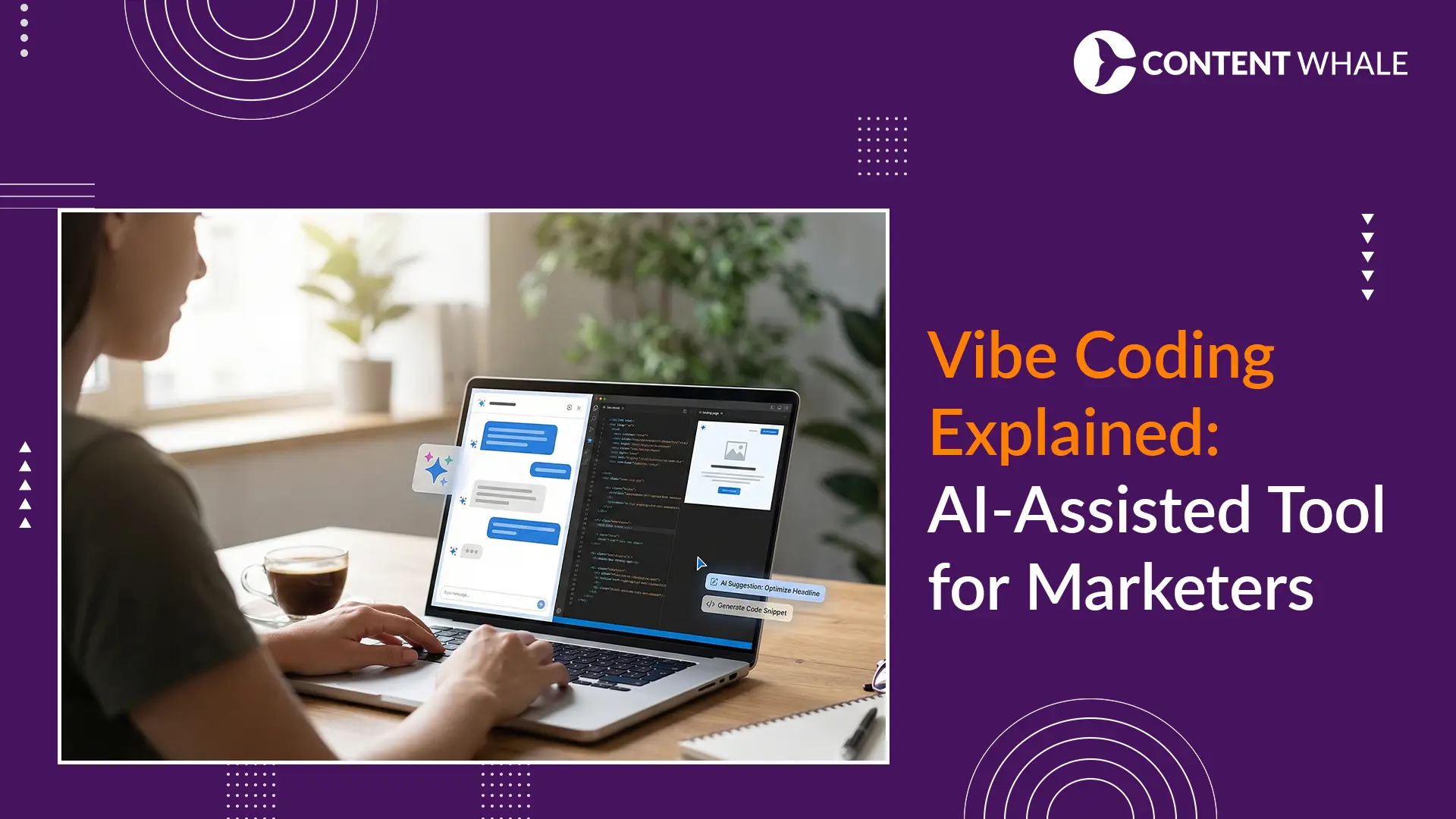
Vibe coding allows marketers to build functional automation tools without writing traditional code. By using natural language prompts with AI platforms like Cursor or Lovable, non-technical users can create custom solutions for repetitive tasks in hours instead of weeks.
According to a survey by HubSpot, majority of marketing professionals report lacking sufficient developer resources for custom tool creation (Source). Vibe coding enables marketers to bypass technical bottlenecks and build personalized systems for SEO audits, PPC analysis, content scheduling, and data visualization.
This guide explores how vibe coding works, where it delivers practical value in marketing workflows, and what realistic limitations exist when building AI-assisted tools.
What Is Vibe Coding?
Vibe coding refers to AI-assisted tool development where users describe desired functionality through natural language prompts rather than writing code manually. The term emerged from discussions about generative AI’s impact on software development and describes a workflow where AI platforms generate, test, and refine code based on conversational instructions.
Unlike traditional coding that requires knowledge of programming languages like Python or JavaScript, vibe coding operates through iterative dialogue.
A marketer might prompt: “Create a tool that pulls keyword rankings from Google Search Console and highlights ranking changes greater than 5 positions.”
The AI generates code, the user tests it, then refines through follow-up prompts like “Add a filter for branded vs. non-branded terms.”
Popular platforms for vibe coding include:
- Cursor: AI-powered code editor with contextual understanding
- Lovable: Focused on rapid prototyping for web applications
- Replit: Browser-based development with AI assistance
- GitHub Copilot: Code completion and generation within existing workflows
Research from Stanford University found that programmers using AI assistants completed tasks 55.8% faster than those coding manually, with the gap largest for developers with less experience (Source). This speed advantage applies even more strongly to non-programmers using vibe code approaches, where the AI handles syntax and structure entirely.
The method differs from no-code platforms in flexibility. While no-code tools like Zapier offer pre-built integrations, vibe coding creates custom solutions without platform limitations. A marketer can build exactly the tool needed rather than adapting workflows to available templates.
However, the approach requires clear thinking about inputs, outputs, and logic flow. Users must understand what they want the tool to accomplish, even if they cannot write the code themselves. The AI assists with implementation, but strategy and requirements remain human responsibilities.
Understanding these fundamentals clarifies how marketers can apply vibe coding to solve specific workflow problems without technical training.
Why Vibe Coding Matters for Marketing Teams?
Marketing departments consistently face a resource allocation problem. Teams need custom tools for campaign analysis, reporting automation, and data processing, but developer time is limited and expensive. A recent report from McKinsey found that 68% of marketing leaders cite technical resource constraints as a barrier to implementing advanced analytics capabilities (Source).
Vibe coding addresses this gap by enabling marketers to prototype and build functional tools independently. Instead of submitting tickets to IT departments and waiting weeks for custom scripts, team members can create solutions within hours. This speed particularly benefits time-sensitive needs like campaign troubleshooting or competitive analysis during product launches.
The approach also reduces costs. External development for custom marketing tools typically ranges from $5,000 to $25,000 depending on complexity. Research from Gartner estimates that AI-assisted development can reduce software development costs by 30-40% through faster iteration and reduced debugging time (Source).
Beyond cost and speed, vibe coding enables personalization that off-the-shelf tools cannot match. Every marketing team has unique reporting formats, client requirements, and workflow preferences. Custom-built tools can incorporate specific keyword lists, brand guidelines, or performance thresholds that generic platforms ignore.
The method excels at automating repetitive analysis tasks. Common applications include:
- Extracting data from multiple API sources and combining into unified reports
- Generating SEO schema markup based on page content
- Analyzing PPC search term reports for negative keyword opportunities
- Creating custom dashboards that pull from Google Analytics, search console, and CRM platforms
- Automating content audits based on specific quality criteria
Research from Harvard Business School found that workers using AI tools completed 12.2% more tasks on average, with quality improvements of 40% for complex assignments. These productivity gains compound when teams can create tools tailored to exact specifications rather than adapting processes to generic software limitations.
The ability to build custom solutions without technical dependencies transforms how marketing teams approach workflow optimization and campaign management.

Practical Applications in Marketing Workflows
Vibe coding delivers measurable impact when applied to specific marketing functions. Rather than general-purpose automation, the most effective implementations target well-defined, repetitive tasks that consume significant time.
SEO and content operations benefit particularly from custom-built tools. Marketers can create systems that:
- Generate structured data markup by analyzing page content and outputting proper JSON-LD format
- Audit large websites for technical SEO issues based on custom criteria beyond standard crawler capabilities
- Compare keyword rankings across multiple locations or competitors with visualization tailored to specific reporting needs
- Extract and categorize backlink data from various sources into unified analysis formats
A case study from the University of Pennsylvania’s Wharton School found that knowledge workers using AI assistance showed productivity increases of 37% when handling analytical tasks (Source). These gains apply directly to SEO analysis workflows where custom tools process data according to specific business rules.
PPC campaign management represents another high-value application area. Custom tools built through vibe coding can:
- Analyze search query reports to identify negative keyword patterns based on campaign-specific criteria
- Calculate optimal budget allocation across campaigns using historical performance data and custom constraints
- Generate ad copy variations by combining performance insights with brand guidelines
- Monitor bid adjustments and flag anomalies that exceed predetermined thresholds
- Consolidate cross-platform data from Google Ads, Microsoft Advertising, and social platforms into unified dashboards
Content marketing workflows benefit from automation that respects brand voice and editorial standards. Tools can:
- Audit content libraries for outdated statistics or broken links using customizable age and quality parameters
- Generate content calendars that account for seasonal trends, product launches, and historical performance patterns
- Analyze competitor content strategies across multiple domains with custom scoring systems
- Create outreach email sequences personalized to specific recipient categories and campaign goals
The key advantage over pre-built solutions lies in specificity. Generic tools force users to adapt their processes to available features. Custom-built tools through vibe code adapt to existing workflows, incorporating unique business logic, client requirements, or industry-specific factors that commercial platforms ignore.
These applications demonstrate how vibe coding moves beyond conceptual potential into measurable workflow improvements for marketing teams handling complex analytical tasks.

Building Your First Tool: A Step-by-Step Framework
Creating functional tools through vibe coding follows a structured process that non-technical users can implement successfully.
Step 1: Identify a high-value automation opportunity
Start with tasks consuming significant time and following predictable patterns. Downloading data from three platforms, combining in spreadsheets, and applying consistent formulas represents an ideal candidate. Avoid starting with complex projects requiring extensive API integration or database management.
Step 2: Define inputs, outputs, and transformation logic
Specify exactly what data the tool receives and what results it produces. For a keyword ranking analyzer: Input = CSV export from ranking tool. Output = Filtered list showing ranking changes over 5 positions with percentage calculations. Transformation = Compare current to previous period, calculate change, filter by threshold.
Step 3: Choose the appropriate platform
- Cursor: Best for marketers comfortable with light code editing and iteration
- Replit: Ideal for web-based tools accessed by teams through browsers
- Lovable: Optimal for rapid prototyping of marketing dashboards and visual interfaces
Research from Carnegie Mellon University indicates that task completion rates with AI coding assistants reach 89.3% for clearly defined problems with specific inputs and outputs (Source).
Step 4: Write initial prompts with specific details
Effective prompts include: expected data format, desired output structure, specific calculations or logic, and error handling requirements. Compare:
- Weak: “Make a tool to analyze keywords”
- Strong: “Create a Python script that reads a CSV with columns ‘keyword’, ‘current_rank’, ‘previous_rank’, calculates rank change as current minus previous, filters for changes greater than 5, and exports to new CSV sorted by absolute change value”
Step 5: Test with real data and refine iteratively
Run the generated tool with actual campaign data. When results do not match expectations, provide specific feedback: “The calculation shows negative numbers when rankings improve. Reverse the subtraction so drops are negative and improvements are positive.”
Step 6: Document for team usage
Create simple instructions covering: where to find input data, how to run the tool, what the outputs mean, and who to contact with questions. Documentation ensures tools remain useful beyond the original creator.
Following this framework enables marketers to build functional automation tools within hours rather than waiting weeks for developer availability.
Realistic Limitations and When to Involve Developers
Vibe coding delivers significant value within specific boundaries. Understanding these constraints prevents wasted effort and ensures appropriate resource allocation.
Quality control remains essential
AI-generated code can contain logical errors, security vulnerabilities, or inefficient implementations that non-technical users may not recognize. This error rate necessitates thorough testing with real data before relying on tools for important decisions.
Complex integrations require professional development
While vibe coding handles straightforward API connections and data processing, projects involving:
- User authentication and security protocols
- Database architecture and optimization
- High-volume data processing at scale
- Integration with enterprise systems requiring compliance standards
- Tools handling sensitive customer or financial data
These scenarios demand professional developers who understand security implications, scalability requirements, and regulatory compliance. Using vibe code for such projects introduces unacceptable risk.
Maintenance creates ongoing obligations
Custom-built tools break when APIs change, data formats shift, or dependencies update. Research from MIT found that software maintenance typically consumes 60-80% of total development costs over a tool’s lifetime (MIT Computer Science & AI Lab, 2023). Teams must either invest time updating tools or accept they may stop functioning.
Platform dependencies limit portability
Tools built through vibe coding often rely on specific AI platforms or cloud services. Migrating to different infrastructure or modifying significantly can prove as difficult as building from scratch. This lock-in effect differs from traditional coding where code can transfer across environments more easily.
The optimal approach combines vibe coding for rapid prototyping with professional development for production systems. Build a proof-of-concept through vibe code to validate the concept. If it proves valuable and sees regular use, have developers rebuild it with proper architecture, testing, and security. This hybrid model maximizes speed while maintaining quality standards.
Recognizing these limitations ensures teams apply vibe coding appropriately rather than creating technical debt or security vulnerabilities.
Integration with Agentic AI Systems
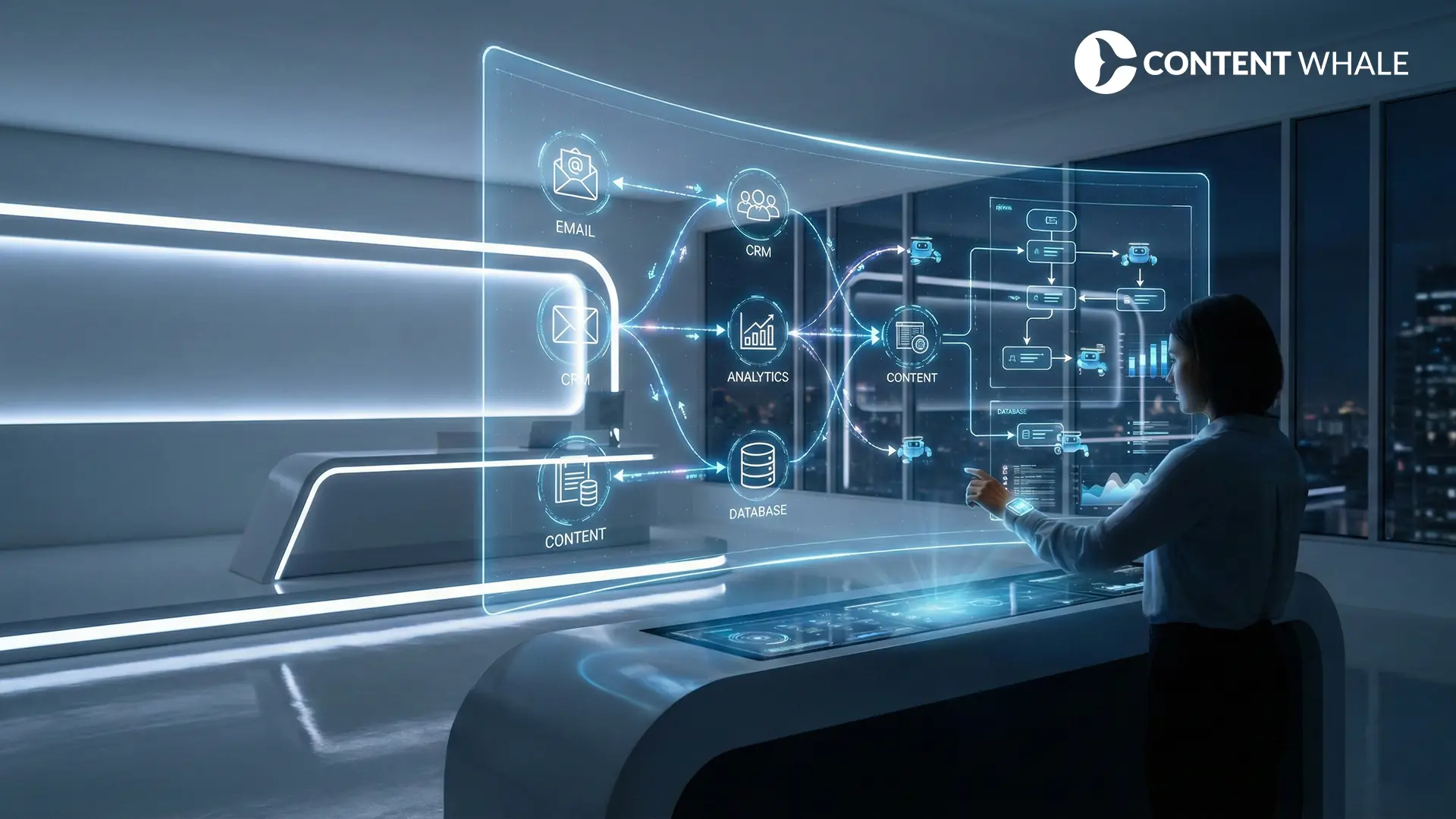
Vibe coding extends beyond building standalone tools into creating custom AI agents that operate with varying levels of autonomy. This progression represents the next phase of marketing automation.
An AI agent differs from a simple tool by incorporating decision-making logic. Rather than processing inputs according to fixed rules, agents evaluate conditions and choose actions based on programmed objectives. A keyword monitoring tool becomes an agent when it not only identifies ranking drops but also generates recommended content updates, estimates effort required, and prioritizes by potential traffic impact.
Current capabilities enable marketers to build agents that:
- Monitor campaign performance metrics and alert teams when thresholds are exceeded
- Analyze competitor activities across multiple channels and suggest counter-strategies
- Generate content variations based on performance data and test systematically
- Optimize budget allocation across campaigns using historical patterns and current performance
Research from Stanford’s Institute for Human-Centered AI projects that autonomous marketing systems will handle 45% of routine optimization tasks by 2027, with human marketers focusing on strategy and creative direction (Source).
However, fully autonomous agents that make spending decisions or publish content without human approval remain limited by platform policies and risk management concerns. Most organizations implement “human-in-the-loop” systems where agents recommend actions but require approval before execution.
The practical path forward involves building increasingly sophisticated tools through vibe coding, then gradually adding decision logic as teams gain confidence in AI outputs. Start with monitoring and alerting, progress to generating recommendations, and only move toward autonomous action after extensive testing with low-risk scenarios.
This evolution from static tools to dynamic agents represents how vibe coding enables custom automation matched to specific team needs and risk tolerance.
Conclusion
Vibe coding provides marketing teams with practical capabilities for building custom automation tools without technical training. However, realistic implementation requires understanding limitations around code quality, security, and maintenance requirements.
The most effective strategy combines vibe coding for rapid prototyping with professional development for production systems handling sensitive data.
Teams that start with simple automation projects and gradually build expertise find vibe coding transforms workflow efficiency without eliminating the need for strategic thinking or quality control.
FAQs
Q: Does vibe coding require any programming knowledge?
No programming experience is required. Vibe coding uses natural language prompts to generate code through AI platforms. Users describe desired functionality conversationally, and the AI handles syntax and implementation. However, understanding basic logic flow improves results significantly.
Q: How long does it take to build a functional marketing tool?
Simple tools for data processing or reporting typically take 2-4 hours including testing and refinement. More complex dashboards or multi-step workflows may require 8-12 hours. Professional developers would need 3-5 times longer for equivalent functionality using traditional coding methods.
Q: What security risks exist with AI-generated code?
AI-generated code can contain vulnerabilities including improper data handling, inadequate input validation, or insecure API connections. Never use vibe code for tools handling sensitive customer data, financial information, or authentication without professional security review and testing against common vulnerabilities.