The most memorable brands in the world are often remembered not just for their products, but for a single line.
A brand tagline can compress an entire company philosophy into a few words. When executed well, it becomes part of cultural vocabulary.
Consider how phrases like “Just Do It” or “Think Different” extend far beyond advertising. They become identity statements.
The philosophy behind these lines reflects the creative mindset popularized by Don Draper in the advertising drama Mad Men. Draper’s character represents the golden era of Madison Avenue advertising, when persuasion relied on psychology, storytelling, and emotional resonance rather than data dashboards.
In one of the show’s most quoted lines, Draper states:
“Advertising is based on one thing: happiness.”
This statement captures a central principle of modern marketing research as well. Studies in consumer psychology and emotional branding consistently show that emotional responses strongly influence purchasing behavior and brand recall.
A strong brand tagline therefore operates as more than clever copywriting. It functions as a strategic messaging device that communicates identity, aspiration, and meaning.
Understanding how these taglines work requires looking at both advertising theory and the cognitive mechanisms that shape consumer memory.
Why a Brand Tagline Matters in Modern Marketing?
A brand tagline performs a structural role in marketing communication. It distills positioning into a concise phrase that audiences can quickly recognize and recall.
Research in marketing science supports this function. Scholars in the Journal of Advertising Research have found that concise messaging structures improve brand recall and recognition because they reduce cognitive load and enhance memory encoding (Source).
In practical marketing terms, a tagline acts as a compressed brand narrative.
It appears across multiple communication touchpoints:
- advertising campaigns
- website copy
- product packaging
- social media messaging
- brand storytelling initiatives
When repeated consistently, the tagline becomes the linguistic shorthand for the brand itself.
Another benefit is message alignment. In large organizations, marketing teams often work across departments and regions. A strong tagline provides a central communication anchor that ensures messaging consistency.
In digital marketing environments, where audiences face constant information overload, simplicity becomes even more valuable. A concise phrase cuts through algorithm-driven feeds and advertising clutter (Source).
This emphasis on simplicity aligns closely with classic advertising philosophy. Draper once summarized the principle in a line frequently quoted by marketers:
“Make it simple. But significant.”
Although the quote originates from a fictional character, the idea reflects a widely accepted principle in communication theory: clarity improves persuasion.
The most successful brand slogans therefore combine clarity with emotional meaning.
The Advertising Philosophy Behind the Don Draper Method
The creative worldview associated with Draper reflects a broader tradition within advertising history.
Mid-20th-century advertising agencies placed strong emphasis on human psychology, narrative symbolism, and aspirational messaging. Rather than focusing solely on product features, campaigns were designed to connect products with emotional experiences.
This approach aligns with findings in behavioral economics and consumer psychology.
Research highlights how consumer decisions are strongly influenced by intuitive emotional responses rather than purely rational evaluation (Source).
In advertising terms, this means consumers often respond more strongly to symbolic meaning than to technical information.
A brand tagline therefore works best when it communicates an emotional idea rather than a product description.
Draper illustrates this in one of the show’s famous pitch scenes, where he explains the nostalgic power of a product carousel:
“This device isn’t a spaceship. It’s a time machine.”
The line reframes a product feature as an emotional narrative. Instead of describing technology, the pitch connects the product with memory and identity.
Modern brand messaging frequently uses the same technique. Successful taglines rarely describe what a product does. Instead, they frame what the product represents.
This insight forms the first principle of effective tagline creation.
Principle One: Emotional Core Before Product Features
A powerful brand tagline begins with emotion.
Traditional marketing often focuses on functional benefits. Yet research in emotional branding demonstrates that consumers frequently choose products that reinforce how they want to feel or who they want to become.
Consider how many iconic slogans avoid direct product descriptions.
Nike’s famous line “Just Do It” does not describe shoes or sportswear. Instead, it communicates determination and personal achievement.
The message resonates because it speaks to identity rather than functionality.
Marketing scholars describe this process as symbolic consumption. Consumers select brands that represent values or aspirations they identify with.
A tagline therefore works best when it reflects an emotional transformation.
The structure typically follows a progression:
Product → Benefit → Emotional Outcome → Identity
For example, a productivity software platform might technically offer collaboration tools. But the emotional benefit could be empowerment or creative freedom.
The resulting tagline might emphasize possibility rather than software functionality.
This emotional emphasis increases memorability because emotional stimuli tend to create stronger neural associations in memory.
In other words, people remember how something makes them feel far longer than they remember technical specifications.
Principle Two: Radical Simplicity
The second principle of the Don Draper method is simplicity.
Cognitive psychology demonstrates that human working memory can only process a limited amount of information at once. Short phrases are therefore easier to encode and recall (Source).
Many iconic brand slogans consist of only a few words.
Short phrases also possess rhythmic qualities that improve linguistic memorability. This is similar to how proverbs or song lyrics become embedded in cultural memory.
A concise tagline also adapts easily across marketing channels. It can appear on packaging, billboards, digital advertisements, and social media without losing clarity.
Draper emphasizes this principle repeatedly in the series when evaluating advertising concepts.
In one scene he dismisses a complicated slogan with a simple critique:
“If you don’t like what’s being said, change the conversation.”
The quote reflects a broader insight about messaging strategy. Effective marketing communication reframes ideas rather than overexplaining them.
A well-constructed tagline therefore communicates a single powerful idea rather than multiple claims.
Simplicity strengthens brand recall and ensures the message remains adaptable across evolving media environments.
Principle Three: Identity Positioning
A brand tagline often functions as an identity signal.
Consumers frequently use brands to express social belonging or personal values. Marketing researchers describe this behavior as identity signaling.
Brands therefore compete not only on product features but also on symbolic meaning.
Technology brands, for example, often position themselves around creativity and innovation. Automotive brands may emphasize freedom, performance, or prestige.
A tagline becomes the linguistic expression of this identity.
When repeated over time, it helps build a psychological connection between the brand and the consumer’s self-image.
Draper articulates this insight in another memorable quote from the series:
“People want to be told what to do so badly that they’ll listen to anyone.”
Although the line is delivered cynically, it reflects an underlying truth about communication strategy. Clear identity messaging provides audiences with a sense of direction and belonging.
When consumers adopt a brand’s tagline as part of their vocabulary, the brand effectively becomes part of their identity narrative.
This is one reason enduring slogans often appear in everyday conversation long after campaigns end.
Principle Four: Cultural Timing
Great taglines also reflect the cultural moment in which they appear.
Advertising history shows that slogans resonate most strongly when they align with broader social narratives (Source).
For example, messaging around individuality and creativity gained prominence during the rise of personal computing and digital entrepreneurship.
Similarly, contemporary marketing often incorporates themes such as sustainability, empowerment, or innovation.
A tagline that captures these cultural ideas can remain relevant for decades because it expresses values that extend beyond specific products.
In Mad Men, Draper often succeeds by recognizing these cultural currents before competitors do. His pitches frequently reinterpret products in ways that align with changing consumer aspirations.
This cultural awareness transforms a simple marketing line into a statement about lifestyle or belief.
Modern brand strategists use similar analysis when developing positioning frameworks.
The most effective taglines therefore function not just as advertising copy but as cultural signals.
Principle Five: Strategic Ambiguity
One surprising feature of many famous slogans is their ambiguity.
Rather than explaining exactly what a company offers, the tagline leaves room for interpretation.
This technique increases engagement because audiences mentally participate in constructing the meaning.
Marketing researchers describe this phenomenon as interpretive participation. When consumers actively interpret a message, they develop stronger cognitive connections to it (Source).
A vague but evocative line encourages imagination.
Draper captures this concept indirectly in another line from the series:
“What you call love was invented by guys like me to sell nylons.”
The quote highlights how advertising often constructs meaning around ordinary products.
Ambiguous taglines operate in a similar way. They invite audiences to attach personal significance to the message.
This interpretive flexibility helps the slogan remain relevant across multiple product generations.
Applying the Don Draper Method to Modern Branding
Although marketing technology has evolved dramatically since the era depicted in Mad Men, the psychological principles behind effective taglines remain largely unchanged.
Digital marketing platforms now rely on data analytics, search algorithms, and performance metrics. Yet these tools primarily optimize distribution rather than message meaning.
A compelling brand tagline still provides the foundation for brand storytelling.
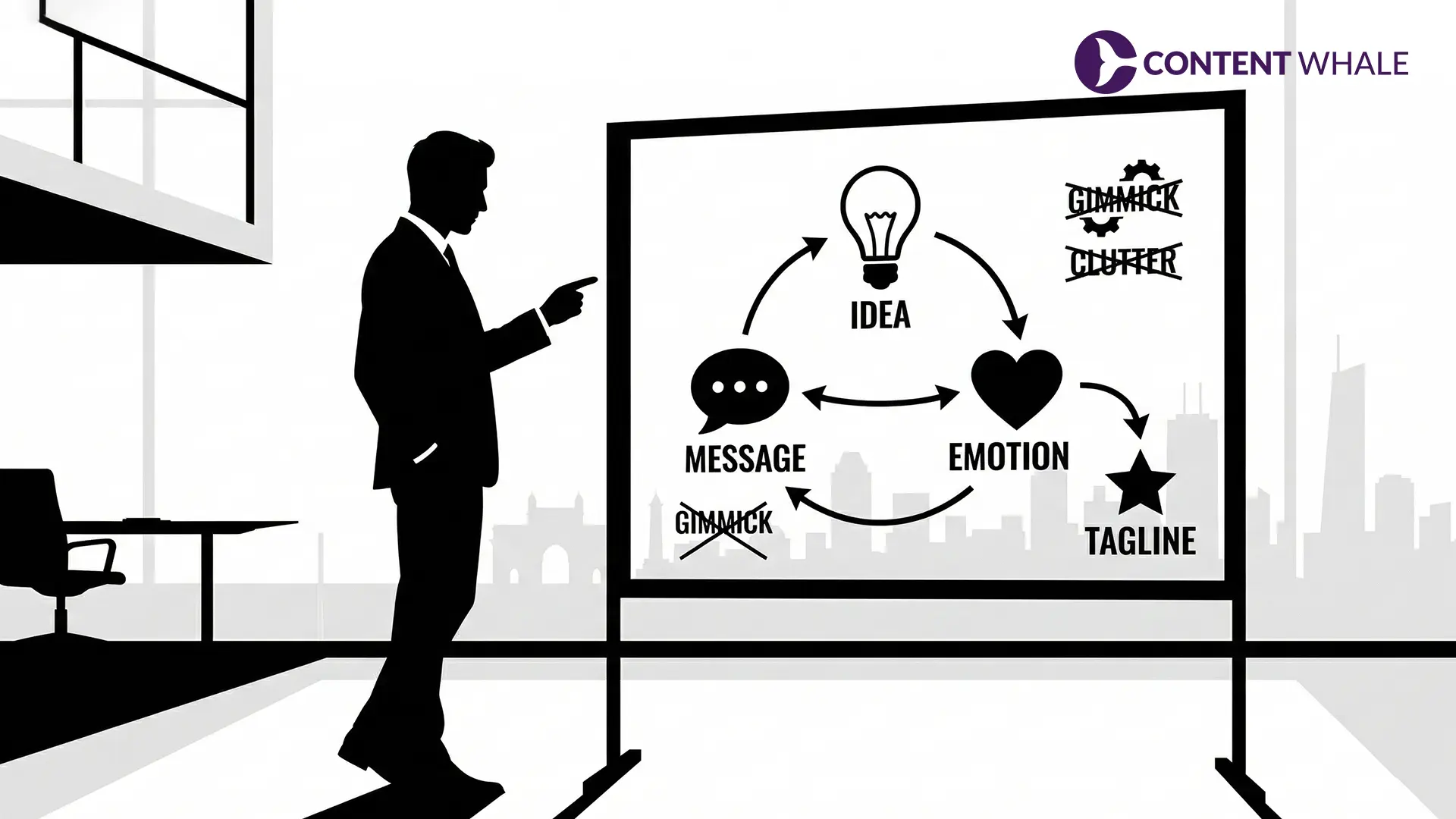
Modern marketers can apply the Draper-inspired framework through a structured process:
First, identify the emotional outcome the brand wants to represent.
Second, define the identity transformation the product enables.
Third, compress this idea into a concise phrase that emphasizes emotion rather than functionality.
Finally, evaluate whether the phrase remains memorable, culturally relevant, and adaptable across marketing channels.
When executed effectively, the result is not merely a marketing slogan but a lasting expression of brand philosophy.
Conclusion
A brand tagline may consist of only a few words, yet its strategic impact can extend across decades.
The principles illustrated through the creative philosophy of Don Draper demonstrate that memorable slogans rely on psychological insight rather than linguistic cleverness alone.
They succeed because they combine:
- emotional resonance
- identity positioning
- simplicity
- cultural awareness
- interpretive flexibility
Technology continues to transform marketing platforms and communication channels. However, the underlying dynamics of persuasion remain remarkably consistent.
Consumers still respond to stories, aspirations, and identity cues.
As Draper succinctly explains in one of the show’s defining moments:
“Advertising is happiness.”
A powerful tagline captures that promise in a single line, turning a brand into something larger than a product. It becomes an idea people want to believe in and remember.