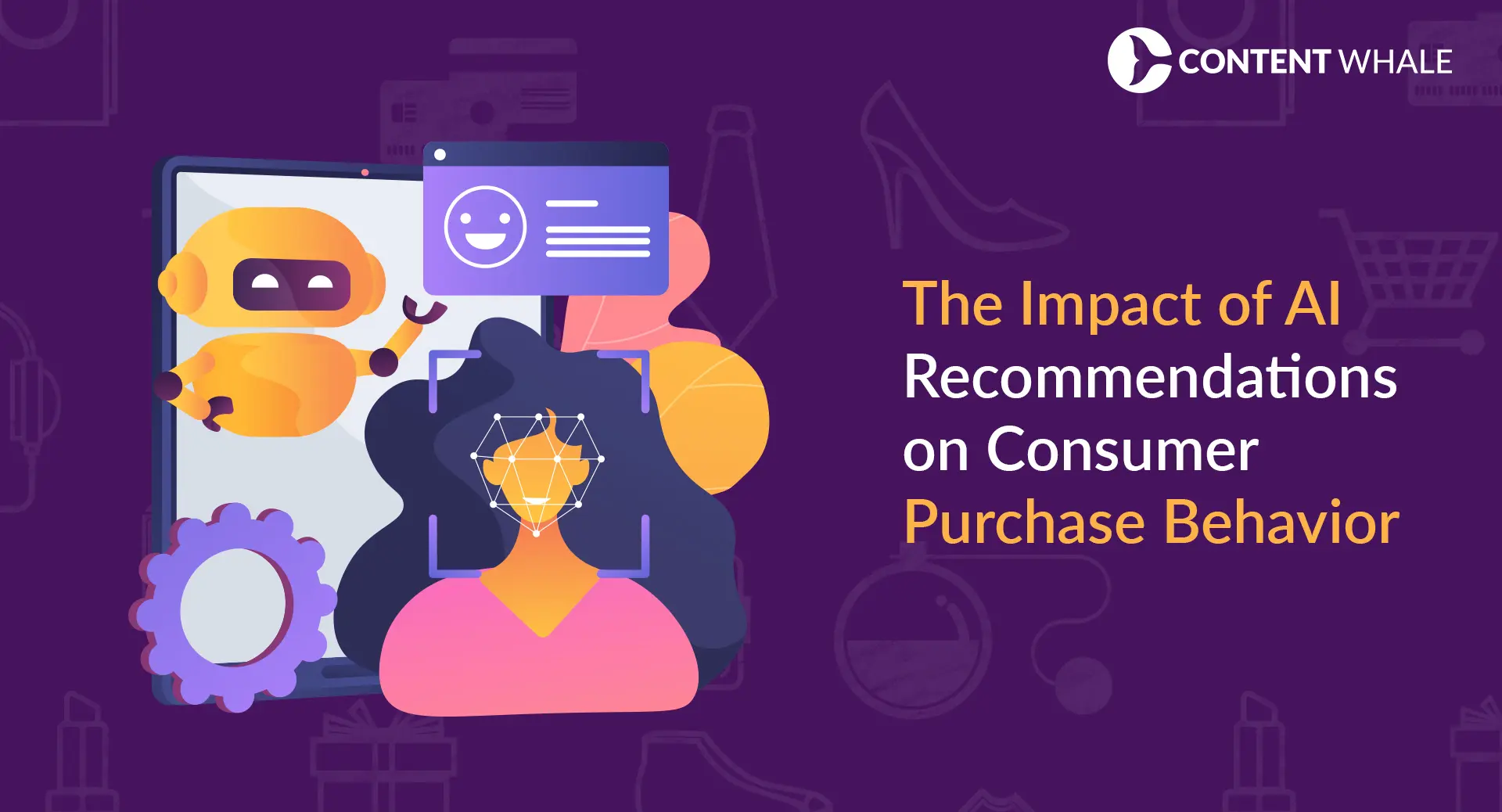
AI recommendations now directly shape the consumer decision-making process. McKinsey research shows companies leading in AI personalization generate 40% more revenue than average performers, with product recommendations increasing revenue by up to 26% per engaged session [Source].
As LLMs like ChatGPT, Gemini, and Perplexity become active participants in the consumer buying process, the way people search, evaluate, and purchase has fundamentally shifted.
This guide will explore how AI recommendations influence each stage of the consumer decision process and what brands need to stay visible inside these new purchase environments.
What AI Recommendation Systems Actually Do?

Definition and Core Purpose
An AI recommendation engine analyzes available data including past behavior, session activity, purchase history, and contextual signals to predict what a user is likely to want next and surface it proactively.
The goal is not simply to display options. It is to reduce friction in the consumer decision-making process by narrowing choices before the user consciously forms a preference.
Three types of recommendation models dominate current implementations:
- Collaborative filtering recommends based on what users with similar behavior selected
- Content-based filtering matches recommendations to characteristics of items already interacted with
- Hybrid models combine both approaches, increasingly powered by deep learning
How LLMs Changed the Architecture?
Traditional recommendation engines relied on structured data such as clicks, ratings, and purchase history. LLMs introduced natural language understanding into the process. A user asking “What’s a good laptop for video editing under $1,200?” receives a contextual, preference-weighted answer rather than a keyword-matched product list.
A 2024 paper in Nature Machine Intelligence found that LLM-integrated recommendation systems outperform traditional collaborative filtering models by 18 to 22% on precision metrics, particularly for users with limited behavioral history [Source]. This matters because cold-start users previously received the weakest recommendations. LLMs close that gap significantly.
AI’s Role at Each Stage of the Consumer Decision-Making Process
The traditional five-stage consumer decision process covering problem recognition, information search, evaluation of alternatives, purchase decision, and post-purchase behavior is being restructured by AI at every point.
Stage 1: Problem Recognition
Before a user articulates a need, AI systems are already identifying purchase intent signals. Behavioral patterns across sessions trigger predictive prompts. A user researching flight prices might see hotel recommendations appear within the same session without a direct search query.
According to Salesforce’s State of the Connected Customer report, 73% of customers expect companies to understand their unique needs and expectations, yet most companies still fall short of that standard. AI-driven problem recognition is directly addressing that gap.
Stage 2: Information Search
Conversational AI has partially replaced traditional SERP-based research. Instead of scanning multiple links, users query ChatGPT, Perplexity, or Google’s AI Overviews for summarized, contextual product information. U.S. retail websites saw a 1,300% increase in traffic from generative AI searches between November and December 2024 compared to the previous year [Source]. That shift is compressing the information search phase faster than any prior channel change.
Visitors arriving from AI search stay on websites 8% longer, view 12% more pages, and bounce 23% less than visitors from traditional search. The consumer buying process is shorter and higher intent, but more dependent on the quality and neutrality of AI training data.
Stage 3: Evaluation of Alternatives
AI-generated comparisons now shape how consumers evaluate competing products. Recommendation engines surface similar items, frequently compared products, and automatically generated pros and cons summaries. LLMs go further by synthesizing reviews, highlighting trade-offs, and ranking options based on conversational context.
Research published in the Journal of Consumer Psychology found that consumers rate AI-generated recommendations as more credible than peer reviews in functional product categories including electronics, appliances, and software, with 61% of respondents attributing expert-level trust to AI suggestions. This positions AI as a de facto evaluator inside the consumer decision process.
Stage 4: Purchase Decision
At the point of purchase, AI recommendations operate through targeted incentives, one-click upsells, and contextual bundling. McKinsey data confirms that companies using AI and real-time consumer data in their marketing strategies see up to a 30% increase in conversion rates [Source]. Dynamic pricing algorithms, powered by the same data infrastructure, personalize price presentation based on estimated willingness to pay.
| Stage | AI Mechanism | Impact Metric |
| Problem Recognition | Predictive behavioral signals | 73% of customers expect pre-stated need awareness |
| Information Search | LLM conversational summaries | 1,300% rise in AI-driven retail traffic in late 2024 |
| Evaluation | AI-generated comparisons | 61% trust AI over peer reviews |
| Purchase | Dynamic upsells and bundling | Up to 30% increase in conversion rates |
| Post-Purchase | Follow-up recommendations | Up to 26% increase in revenue per session |
Stage 5: Post-Purchase Behavior
AI continues after the transaction. Post-purchase sequences include follow-up product suggestions, loyalty nudges, and AI-assisted support. According to Barilliance research, product recommendations account for as much as 31% of ecommerce revenue overall, with engaged sessions showing revenue lifts of up to 26%. Brands that ignore post-purchase AI touchpoints are leaving a substantial portion of recoverable revenue unaddressed.

The Emerging Role of Ads Inside AI Responses
One of the most consequential developments in the consumer decision-making process is the introduction of sponsored placements inside LLM interfaces.
How In-AI Advertising Works?
OpenAI began testing ads inside ChatGPT for free-tier and ChatGPT Go users in late 2025. Sponsored placements appear at the bottom of AI responses when the conversation context is commercially relevant, labeled clearly as ads and separated from the organic answer.
Initial CPM rates for these placements have been reported at approximately $60 per thousand impressions, with attribution limited to impressions and clicks. This is a premium placement given the high-intent nature of conversational queries.
This matters for the consumer buying process because:
- The query context is already purchase-adjacent
- The user is in an active decision-support mode
- The AI response has already primed product consideration before the ad appears
The Trust Problem and Competing Approaches
Not all AI companies are moving in the same direction. Anthropic has maintained that Claude products remain ad-free, stating publicly that advertising risks undermining the usefulness and trustworthiness of AI responses. Perplexity tested ads early but scaled back after user feedback indicated concerns about blending sponsored content with research-oriented answers.
This divergence matters for brands. An AI trusted as an objective advisor carries more influence over the consumer decision process. Users tend to discount all recommendations once they recognize commercial intent behind the interface.
A 2024 paper in Computers in Human Behavior found that perceived AI bias including suspicion of commercial motives reduces recommendation acceptance rates by up to 38% [Source]. Brands considering in-AI placements need to weigh visibility against the trust cost that comes with it.
Psychological Mechanisms Driving AI Recommendation Effectiveness
Several cognitive factors explain why AI recommendations exert strong influence over the consumer decision-making process:
- Choice architecture limits the option set, reducing decision fatigue and increasing the probability that surfaced options convert
- Framing effects shift selection based on how AI presents comparisons. “Most popular” versus “best value” meaningfully changes what users choose
- Trust transfer means that when a user trusts the AI platform, that trust partially extends to the products it recommends, functioning as implicit endorsement
- Reduced cognitive load leads users to offload evaluation to the AI, particularly in high-complexity or low-familiarity categories
Strategic Implications for Brands
Brands operating in AI-influenced purchase environments need to rethink traditional channel assumptions:
- Product data quality matters more. Recommendation engines surface products based on structured data. Incomplete or inconsistent product listings reduce AI visibility directly. ChatGPT responses using structured pages scored 30% higher for accuracy, completeness, and presentation quality than unstructured counterparts
- Conversational optimization is necessary. Content must answer specific, intent-driven questions to appear in LLM responses, not just rank on traditional SERPs
- Review signals feed AI comparisons. AI systems aggregate sentiment from reviews. Volume and recency of positive reviews directly affect recommendation positioning
- Early entry into in-AI advertising. With CPMs still forming and competition limited, early adopters in LLM ad placements gain category presence at lower cost than established digital channels

Ethical Considerations and Challenges
The acceleration of AI within the consumer buying process creates accountability gaps:
- Opacity in recommendation logic means users cannot easily determine why a product was recommended or whether commercial relationships influenced the output
- Data privacy concerns arise from behavioral profiling required for personalization, raising compliance issues under GDPR, CCPA, and emerging AI-specific frameworks
- Algorithmic homogenization reduces discovery of niche or newer brands, concentrating purchase flow toward already-dominant players
A 2024 European Commission report on AI in digital markets flagged recommendation systems as a primary area requiring transparency obligations under the AI Act, specifically concerning undisclosed commercial influence on consumer choices.
Measuring AI’s Influence on Purchase Behavior
Standard attribution models were not built for conversational AI touchpoints. New measurement frameworks are being developed:
- AI-assisted conversion rate tracks purchases where an LLM interaction occurred within the decision window
- Recommendation engagement rate measures click-through from AI surface to product page
- Assisted attribution in AI sessions identifies AI as a contributing touchpoint within multi-channel journeys
AI referral traffic currently accounts for around 1% of all website traffic across industries but is growing at roughly 1% month over month, with IT and consumer staples sectors already seeing the highest share [Source]. Brands that start tracking this now will have a significant head start on attribution accuracy.
Conclusion
AI recommendations are now central to the consumer decision-making process. From behavioral signals triggering early awareness to contextual upsells at checkout, the consumer buying process has structurally changed. Brands that invest in structured content, data quality, and review signals optimized for LLM visibility will hold a measurable advantage as AI-driven discovery becomes the default purchase channel.
Content Whale works with brands to build exactly that kind of content infrastructure. If your team needs SEO and content assets built for AI search visibility, reach out to get started.
Frequently Asked Questions
How do AI recommendations influence the consumer decision-making process?
AI recommendations shorten the consumer decision-making process by surfacing relevant products before users articulate a need, compressing research time and increasing purchase intent at every stage.
What is the difference between the consumer decision process and the consumer buying process?
The consumer decision process covers all five stages from problem recognition to post-purchase behavior. The consumer buying process refers specifically to the steps leading to the final purchase action.
How are LLMs changing the consumer buying process?
LLMs replace keyword-based search with conversational product discovery, giving users summarized comparisons and contextual suggestions that directly influence evaluation and purchase decisions faster than traditional search.
Why should brands optimize content for AI recommendations?
Brands with structured, intent-driven content appear more frequently in LLM responses. This increases visibility during the consumer decision process and drives higher-intent traffic than conventional search channels.