



 BFSI
BFSI HealthCare
 Edtech
 SaaS
SaaS Automobile
 Travel
Over 58.5% of Google searches in 2024 ended without a click, users got answers from AI-generated responses before opening any result.
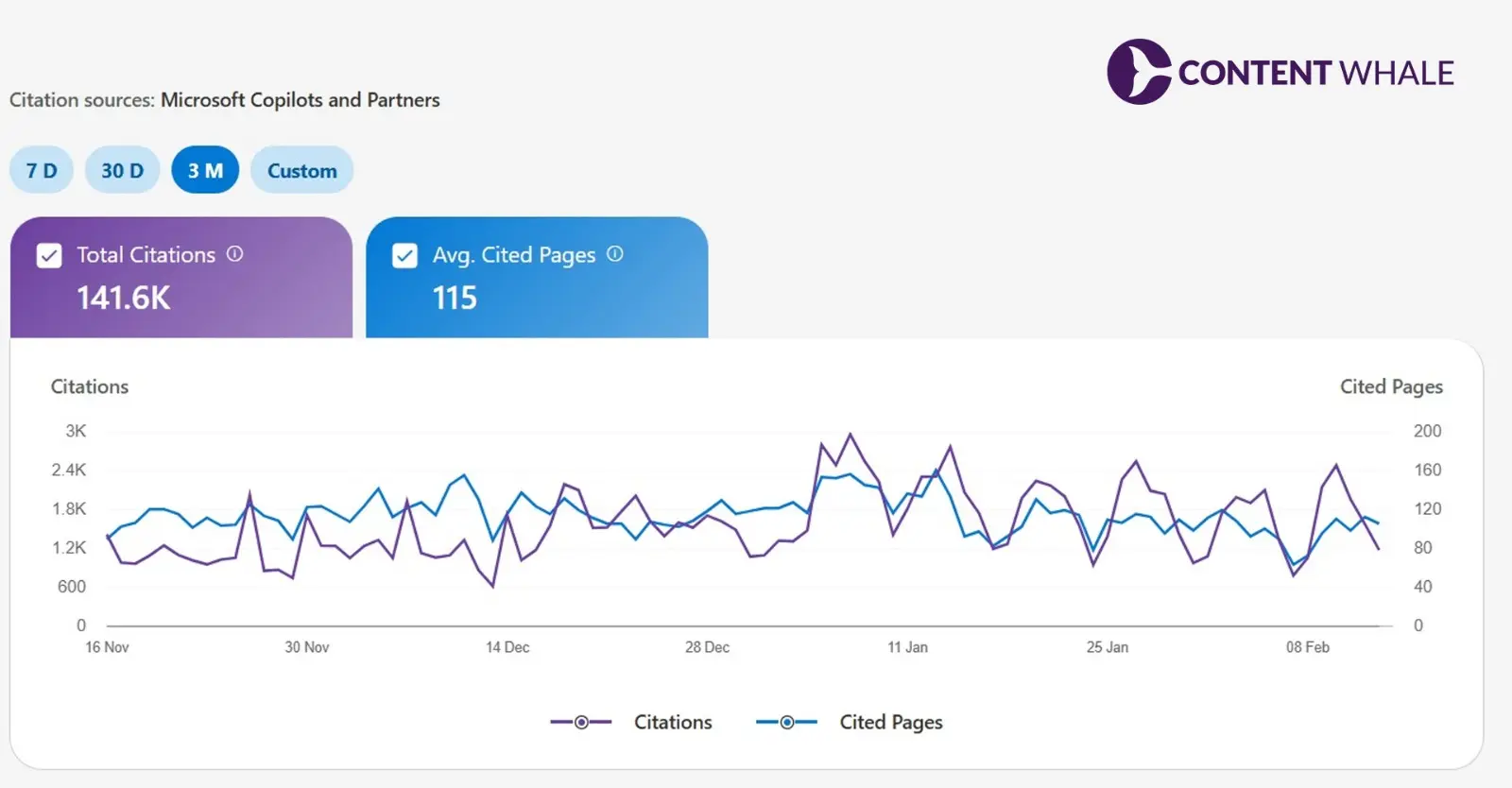
The new question is not where you rank. It’s whether AI systems cite your content when building those answers. At Content Whale, our content writing agency recorded 141.6K total AI citations on Microsoft Copilot in three months, with 115 cited pages on average per period. BrightEdge confirms AI Overviews now appear in 84% of informational and commercial queries.
This guide breaks down the exact framework we used to engineer AI citation authority from content structure to internal linking to quarterly refresh cadence.
What AI Citation Authority Actually Means?
AI citation authority is the consistent selection of your domain’s content by AI platforms when generating answers. It is not the same as backlink authority, it reflects structural credibility: how well your content is organized, sourced, and formatted for machine extraction.
Why AI Systems Cite Specific Sources?
A 2023 Princeton and MIT study on LLM source selection found models favor content with explicit definitions, sourced data, and logical hierarchy over dense, unstructured prose. [Source]
AI systems specifically prioritize:
- Pages with clear H2/H3 hierarchy that separates topics
- Content defining its subject within the first 100–150 words
- Articles citing verifiable data from credible, institutional sources
- Domains with consistent topical depth across multiple related URLs
AI Citations vs. Traditional Rankings
A page at position 3 can never appear in an AI response. A page on page 2 can be cited consistently if its structure signals authority. Rankings measure index visibility. AI citations measure recognized expertise inside generated responses. Both require separate optimization strategies.
The Strategic Shift: From Traffic-First to Authority-First
Content Whale’s internal pivot required three core changes:
- Depth over volume — fewer articles, each significantly more comprehensive and semantically complete
- Context over keyword stuffing — semantic coverage of related subtopics, not density-driven writing
- Clarity over filler — every paragraph required a specific, extractable answer
Blog posts stopped being individual traffic units. Each became a knowledge node — connected to adjacent content that collectively signals topical authority to AI platforms and search engines simultaneously. This is the operational basis of generative engine optimization.
The Framework We Used to Build AI Citation Authority
 SEO, structured content strategy” width=”1920″ height=”1080″ />
1. Topic Cluster Architecture
Pillar pages at 2,500–3,000+ words covered core subject areas, with tightly linked support articles addressing every related subtopic. Cluster maps were finalized before writing began — ensuring semantic depth across the full topic, not just the primary keyword page.
- Pillar pages provide comprehensive coverage of the core topic
- Support articles answer specific subtopic and long-tail queries
- Internal links connect every related URL bidirectionally
- No orphan pages — every new URL links from at least two existing pages
Key Insight: AI systems interpret clustered topical strength as evidence of authoritative, organized coverage — not just one high-performing page with no contextual support.
2. Definition-Led Content Structuring
Every article opens with a clear, concise definition of its primary topic within the first 100–150 words. Structured subheadings with short answer blocks follow — built for direct AI extraction and featured snippet selection.
- Definitions in the introduction — never buried mid-article
- FAQ sections use question-format H3s with 40–60 word answers
- Short answer blocks under each subheading address specific query variants
- Bullet formatting for all lists instead of prose-embedded lists
Key Insight: AI models extract structured, direct answers significantly faster than long-form prose without structural anchors. Formatting is a functional SEO decision, not a cosmetic one.
3. Data-Backed Publishing
Every article includes 5–6 verified data points from academic, government, or research-grade sources, each with a direct citation link. Non-negotiable across all content writing agency output.
- No claim published without a linked, verifiable source
- Statistics sourced from peer-reviewed or institutional publishers only
- Fact-based sections with transparent, inline sourcing
- Figures refreshed on quarterly content review cycles
Key Insight: Authority compounds when content is verifiable. AI platforms treat sourced, factual content as higher-confidence material and select it over unsupported claims.
4. Internal Linking as Authority Distribution
A full audit redistributed link equity from high-backlink pages toward newer cluster content. Anchor text was made contextual and varied, no over-optimized exact-match patterns.
- Contextual anchors matched to the linked page’s core topic
- High-authority URLs directed equity toward newer cluster support articles
- Thin, cannibalized pages consolidated into comprehensive single URLs
- Site architecture simplified to maximum 3-click depth for key content
Key Insight: AI systems interpret strong internal architecture as thematic coherence — evidence the domain owns a subject comprehensively, not sporadically.
5. Content Refresh Cadence
Quarterly updates became a fixed publishing cycle. Every article with a statistic or trend reference was flagged for review. Timestamps were updated only after substantive content changes — not cosmetic edits.
- Quarterly review of all pillar pages and cluster support articles
- Updated statistics with current figures and refreshed source links
- Expanded sections covering AI algorithm updates and search behavior shifts
- Deprecated claims removed and replaced with current, verified data
Key Insight: AI platforms favor fresh, dated references. A 2025 statistic signals current relevance. A 2021 figure signals content that may no longer reflect its subject accurately.
What Changed After the Shift?
The 141.6K citations recorded on Microsoft Copilot over three months reflect 18 months of structural investment. AI citation authority builds over 90–180 days as AI crawlers reassess domain topical strength. Outcomes after full framework deployment:
- Broader cited page distribution — 115 pages cited on average per period, not dependence on a single URL
- Consistent AI citation visibility across branded and non-branded informational queries
- Brand name appearing inside AI-generated response paragraphs, not only as footnote attribution
- Domain cited across adjacent topic areas beyond a single primary keyword cluster
These outcomes validate the structural strategy. AI citation authority is the output of deliberate content architecture — not post volume or ad spend.

Key Lessons for Content Writing Agencies
- AI citations are engineered, not accidental. Agencies that get cited build for extractability: clear definitions, structured subheadings, sourced data.
- Authority compounds when structure improves. Each article meeting the structural standard adds cumulatively to the domain’s AI citation signal.
- Topic clusters outperform scattered publishing. Ten tightly linked articles on one topic generate more AI citation signals than 50 isolated posts on 50 different subjects.
- Formatting clarity increases extractability. AI models extract from structured content faster and more accurately than from dense prose.
- Rankings and citations must be optimized together. Rankings drive discovery; AI citations drive authority perception. Both contribute to long-term search visibility.
Common Mistakes That Block AI Citation Growth
- Publishing thin blog posts targeting a single keyword with no semantic depth or related-topic coverage
- Over-optimized exact-match anchor text that signals manipulation rather than contextual relevance
- No explicit definitions — content assumes reader knowledge instead of establishing it for AI extraction
- Ignoring informational search intent and publishing only commercial-intent content
- Building without cluster logic — isolated articles with no internal linking architecture
- Failing to source claims — AI platforms actively deprioritize unverifiable content when selecting citations
Â

Why AI Citation Authority Is the Competitive MOAT of 2026?
A 2024 Gartner forecast projected traditional search volume will drop by 25% by 2026 as AI-powered interfaces absorb query traffic.
Brands cited early in AI-generated answers influence buyer perception at the top of the funnel, before a prospect evaluates competitors or visits a website. Forrester Research found 74% of B2B buyers complete more than half their research before contacting a vendor.
AI citation authority is a defensible competitive position because it is slow to build and difficult to replicate quickly. Structural content investment now creates citation positions competitors cannot match through short-term publishing bursts.
Conclusion
Rankings measure index visibility. Backlinks measure external popularity. AI citations measure recognized expertise — the standard AI systems apply when selecting sources for answers that reach users before any click happens.
The citations Content Whale achieved over three months on Microsoft Copilot are the result of 18 months of structural content investment: topic clusters, definition-led structuring, data-backed publishing, contextual internal linking, and consistent refresh cycles.
Ready to build AI citation authority for your brand? Partner with Content Whale, visit content-whale.com to start your strategy today.
Frequently Asked Questions
What is AI citation, and how is it different from a regular backlink?Â
AI citation is when a platform like Copilot or Google AI Overviews references your content in a generated answer. Unlike backlinks, AI citations reflect structural credibility and content extractability, not external popularity signals.
How long does it take to see AI citation results from a content writing agency?Â
AI citation authority typically builds over 90–180 days. AI crawlers reassess domain topical strength gradually. Structural improvements in content architecture, internal linking, and data sourcing drive results over time, not overnight.
What content structure does a content writing agency need to get cited by AI?Â
Pillar pages with 2,500+ words, definition-led introductions, sourced data, FAQ sections, and tight topic cluster linking are the core requirements. AI systems favor structured, verifiable, and topically comprehensive content over dense, unstructured prose.





 Content Whale – USA


