



 BFSI
BFSI HealthCare
 Edtech
 SaaS
SaaS Automobile
 Travel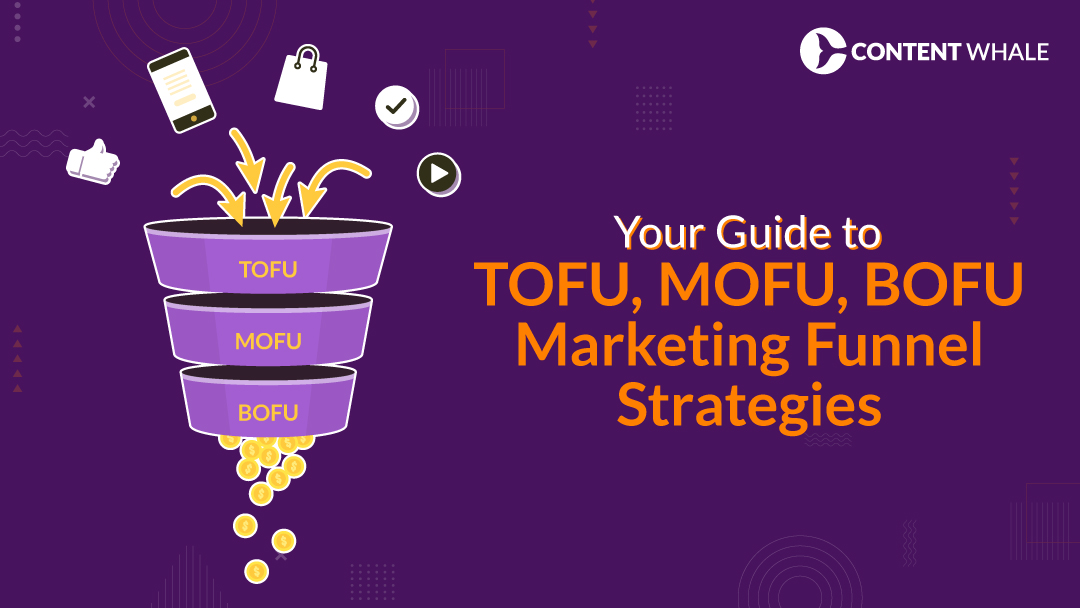
Only 4% of website visitors are ready to buy on their first visit, while 96% need nurturing across multiple touchpoints before conversion. That gap is exactly what the TOFU MOFU BOFU marketing framework is built to close. Brands that map content to buyer-stage intent see 73% higher conversion rates than those pushing generic messaging at every visitor.
The funnel works because buyers do not arrive ready. B2B buyers consume an average of 13 content pieces before purchase, and each piece sits at a specific funnel stage. This guide will explain what each stage requires, the content that fits, the metrics that prove it is working, and the mistakes that drain budgets.
What is the TOFU MOFU BOFU marketing strategy?
The TOFU MOFU BOFU framework is a three-stage system that maps content to buyer intent: TOFU (Top of Funnel) drives awareness, MOFU (Middle of Funnel) builds consideration, and BOFU (Bottom of Funnel) closes the sale. Each stage uses distinct content formats and conversion metrics.
Skipping a stage, or weighting one over the others, produces leakage: traffic without leads, leads without sales, or sales without retention. The TOFU MOFU BOFU model keeps the buyer journey continuous instead of fragmented across disconnected campaigns.
TOFU: Top of Funnel content that drives awareness
The TOFU stage targets prospects who do not yet know your brand exists. The job here is reach, not conversion. Pushing sales messages this early is the single most common reason cold traffic bounces.
What TOFU content looks like?
- SEO blog posts answering common industry questions
- Short-form social posts built for share velocity
- Educational YouTube videos and explainers
- Infographics that distil data into shareable visuals
- Podcast guest appearances for audience borrowing
- Free tools and calculators that solve one small problem
TOFU keyword intent
Target informational queries: “what is”, “how does”, “why does”, “examples of”. These keywords carry the highest search volume and the lowest commercial intent, which is correct for the awareness layer of the TOFU MOFU BOFU funnel.
TOFU metrics that matter
| Metric | What it measures | Healthy benchmark |
| Organic impressions | Reach | 10K+ monthly per cluster |
| Pageviews | Content consumption | 5K+ monthly per post |
| Average time on page | Engagement quality | 2+ minutes |
| Social shares | Resonance | 50+ per post |
| Branded search lift | Awareness impact | 15-25% YoY |
Raw impressions only matter if they translate into MOFU pipeline. The TOFU layer of the marketing funnel should be measured by what it feeds, not what it captures alone.
MOFU: Middle of Funnel content that builds consideration
Once a prospect knows you exist, the MOFU stage builds trust. This is where 68% of B2B deals stall, because brands invest heavily in TOFU traffic and BOFU sales pages while leaving the consideration phase thin (Source).
What MOFU content looks like?
- Comparison guides covering X vs Y vs Z
- Case studies with specific outcomes and numbers
- Webinars that solve a defined problem
- Long-form research reports with original data
- Email nurture sequences carrying educational value
- Templates and frameworks the prospect can apply immediately
MOFU keyword intent
Target commercial-investigation queries: “best”, “vs”, “alternative to”, “review”, “for [specific use case]”. These signal active research, not browsing.
MOFU metrics that matter
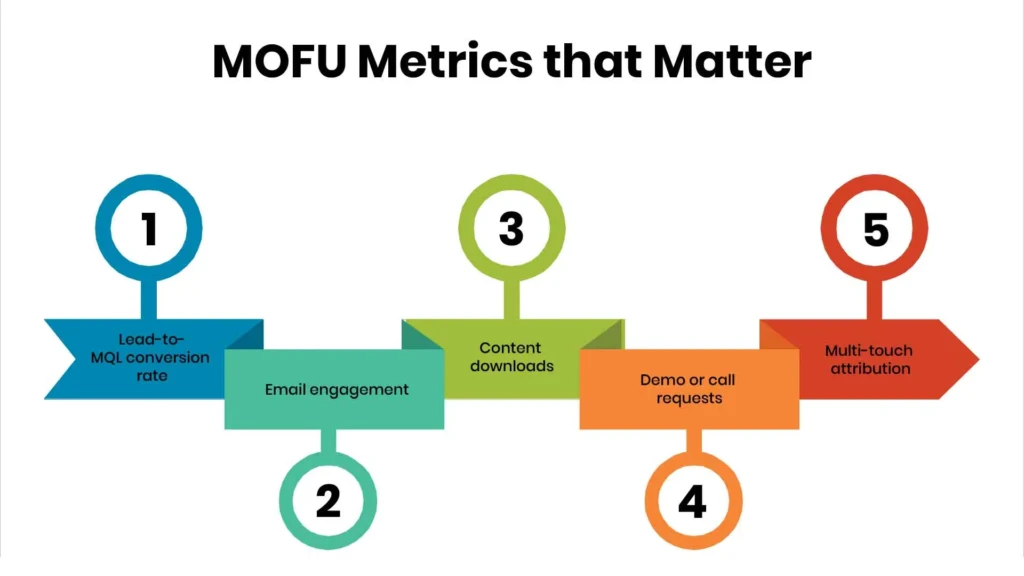
- Lead-to-MQL conversion rate. Industry average sits at 13%, per the 2025 RevOps benchmark.
- Email engagement. Open rates above 25%, click-through above 3.5%.
- Content downloads. Gated asset conversion above 20% on a warm list.
- Demo or call requests. The strongest leading indicator of BOFU readiness.
- Multi-touch attribution. Track which MOFU asset preceded conversion to identify high-leverage formats.
The mistake most teams make at this stage of the digital marketing TOFU MOFU BOFU framework is publishing thin comparison content. Real research firms publish 8-10 page comparison guides backed by primary data. Publishing a 600-word listicle in the same SERP loses every time.
BOFU: Bottom of Funnel content that closes the sale
BOFU is where intent converts into revenue. The prospect already knows the problem, the category, and the shortlist. They need a final reason to pick you. Pages built for the closing layer of the sales funnel TOFU MOFU BOFU should remove friction and reinforce confidence.
What BOFU content looks like?
- Product or service pages with clear pricing
- Free trials, demos, and pilot programmes
- Customer testimonials with named clients and outcomes
- ROI calculators tied to the prospect’s industry
- Implementation guides showing the first 30 days post-purchase
- Comparison pages that handle competitor objections directly
BOFU keyword intent
Target transactional queries: “pricing”, “demo”, “free trial”, “buy”, “[brand] vs [competitor]”. Search volume is lower at this stage, but conversion rate is 5-10x higher than TOFU traffic.
BOFU metrics that matter
| Metric | Healthy benchmark |
| Demo request rate | 3-5% of qualified MOFU traffic |
| Free trial activation | 60%+ of signups complete onboarding |
| Sales-qualified lead rate | 20-25% of MQLs |
| Closed-won rate | 15-30% depending on ACV |
| Average sales cycle | Track and compress against baseline |
Discounting at the BOFU stage is the most expensive shortcut in the marketing TOFU MOFU BOFU model. It compresses margin permanently while only marginally increasing close rate. Better levers: faster onboarding, named-customer proof, and risk reversal through guarantees.
How to integrate TOFU, MOFU, and BOFU into one system?
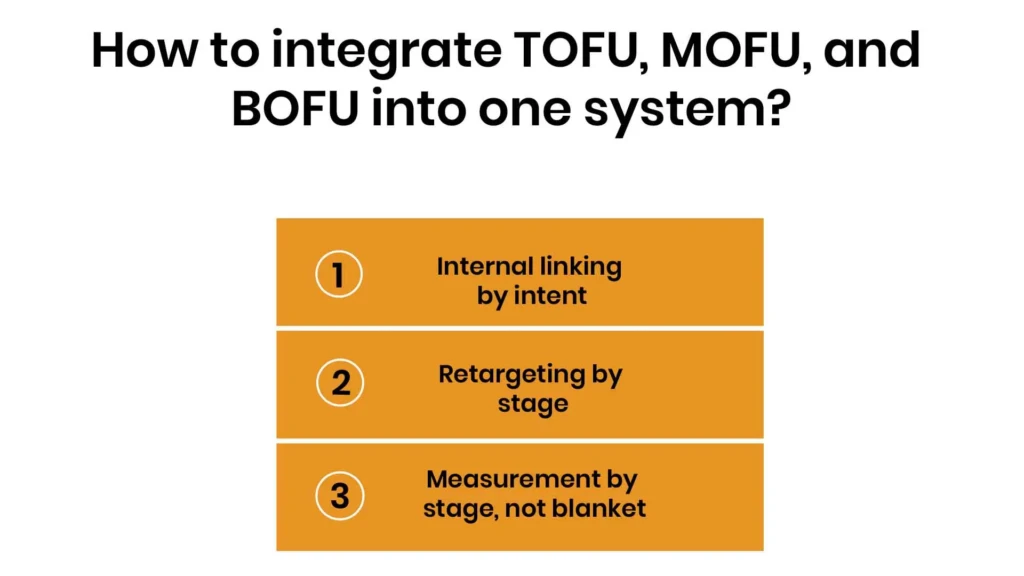
Stage isolation is the failure mode. Each piece of content should hand off cleanly to the next stage. Three principles keep the TOFU MOFU BOFU strategy continuous:
- Internal linking by intent. Every TOFU blog should link to two MOFU assets. Every MOFU asset should link to one BOFU page. The path from awareness to demo should never exceed three clicks.
- Retargeting by stage. Cold traffic sees TOFU ads. MOFU visitors see comparison and case-study ads. BOFU visitors see demo and pricing ads. Stage-mismatched ads cost 3x more per conversion.
- Measurement by stage, not blanket. Pageviews matter for TOFU. Lead quality matters for MOFU. Closed revenue matters for BOFU. Applying one metric across all three stages of the digital marketing TOFU MOFU BOFU framework produces wrong decisions.
Common mistakes in TOFU MOFU BOFU marketing strategy execution
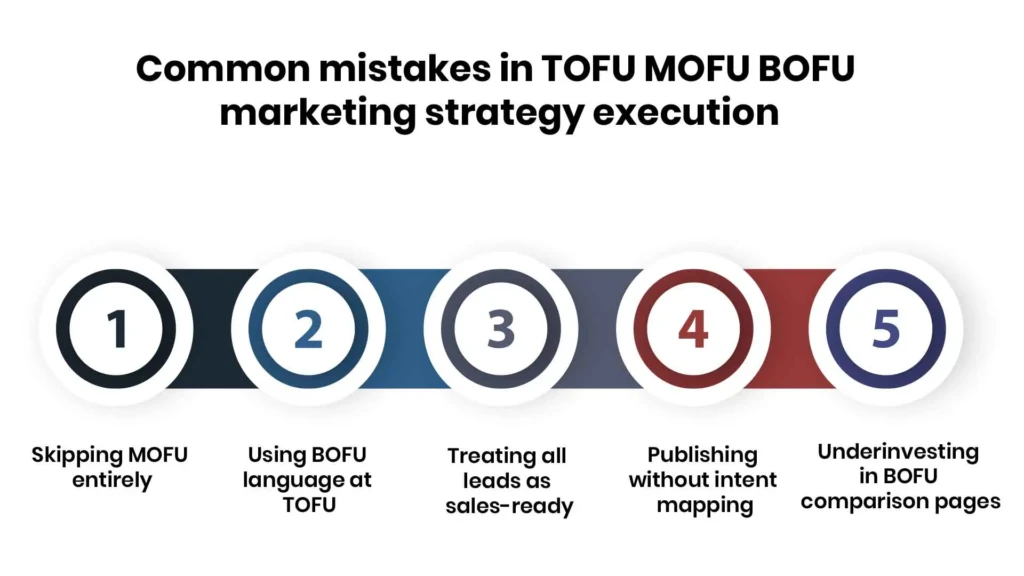
- Skipping MOFU entirely. Brands publish blog posts and pricing pages with nothing in between. The result is high traffic and low conversion.
- Using BOFU language at TOFU. Sales-heavy copy on cold traffic kills engagement. Save the close for visitors who have already engaged with three or more assets.
- Treating all leads as sales-ready. Passing TOFU email signups directly to sales burns out the SDR team and damages list health.
- Publishing without intent mapping. Writing content based on keyword volume alone, without funnel placement, produces traffic that never converts.
- Underinvesting in BOFU comparison pages. Most brands have one weak pricing page. The brands winning competitive deals have 8-12 BOFU comparison pages, one per competitor.
FAQs
What is the difference between TOFU, MOFU, and BOFU?
TOFU is awareness content for prospects discovering the problem. MOFU is consideration content for prospects evaluating options. BOFU is decision content for prospects ready to buy. The three stages cover the entire buyer journey from first touch to conversion.
How much budget should go to each funnel stage?
A common split is 40% TOFU, 40% MOFU, 20% BOFU, but the right ratio depends on traffic volume and conversion gaps. Brands with strong TOFU traffic but low conversion should reweight toward MOFU. Brands with low traffic should reweight toward TOFU.
Can the TOFU MOFU BOFU model work for small businesses?
Yes. Small businesses run leaner versions of the same framework: one strong TOFU blog cluster, two or three MOFU assets, and a single high-converting BOFU page. The structure matters more than the volume.
How long does it take to see results from a TOFU MOFU BOFU marketing strategy?
TOFU SEO content typically takes 3-6 months to rank. MOFU email nurtures can show conversion lift within 4-6 weeks. BOFU pages tied to existing demand can convert within days of publishing.
Which tools support a full-funnel content strategy?
Google Analytics 4 for traffic, HubSpot or ActiveCampaign for nurture, Ahrefs or Semrush for keyword mapping by stage, and a CRM like Salesforce or HubSpot for closed-loop attribution. Tool choice matters less than connecting them so stage transitions are visible.
Conclusion
The TOFU MOFU BOFU marketing strategy succeeds when each stage carries weight independently and connects cleanly to the next. Audit one stage this week: pull the conversion rate from TOFU to MOFU on your top 10 blog posts, identify the weakest handoff, and rebuild that bridge before publishing anything new. Connect with Content Whale team to map your full-funnel content plan and close the gaps draining your pipeline today.




 Content Whale – USA


