Roughly 7.5 million blog posts go live every day, and most of them earn zero backlinks, per Ahrefs data compiled in Backlinko’s 2026 blogging statistics roundup. Search has turned hostile to article writing built for algorithms instead of readers. AI Overviews now reduce organic click-through on informational queries by an estimated 61%, and Google’s December 2025 core update specifically punished word-count padding over genuine depth (SaaSUltra Blogging Statistics 2026).
I’m Akash Sharma, SEO Manager at Content Whale, and I’ve spent five years watching the article writing rulebook get rewritten three times. The version that worked in 2022, stuffed with keywords and generic definitions, got wiped out in the March 2024 Helpful Content Update and again in the December 2025 core update.
This guide will explain what article writing actually means in 2026, the types and format that hold up in search today, how writers earn from them, and the five mistakes I see kill rankings in every client audit I run.
What Is Article Writing?
Article writing is the process of producing structured, factual, reader-first content published in newspapers, magazines, websites, or journals, to inform, persuade, narrate, or describe a specific topic for a defined audience.
In practice, that definition has shifted hard. Ten years ago, articles were judged by how well they read. Today, they are judged by how well they answer a specific search intent, how independently each section can stand as a citable passage for AI Overviews, and whether the author has demonstrable experience with the topic. Google’s March 2024 core update rolled the Helpful Content signals into the core ranking system and cut low-quality content by an estimated 40%. In 2026, article writing is less about word count and more about accuracy density.
Article Writing vs Blogging vs Essays vs News Writing: What’s the Difference?
Article writing publishes factual, third-person content for a broad audience on a specific topic. Blogging is more personal and serialised. Essays are academic and argument-driven. News writing reports verified facts using the inverted-pyramid structure. Each format carries a different reader contract.
| Format | Voice | Structure | Purpose | Typical Length |
| Article | Third-person, factual | Intro, body, conclusion | Inform or explain | 800–2,500 words |
| Blog post | First or third person | Conversational, scannable | Build audience, rank | 500–2,500 words |
| Essay | First person, academic | Thesis, argument, close | Persuade through reasoning | 1,000–5,000 words |
| News article | Reporter voice | Inverted pyramid | Report verified facts | 300–1,200 words |
| Social post | Any | No fixed format | Reach, reaction | Under 300 words |
The boundaries have blurred. Most modern web articles borrow from blog format while keeping the factual discipline of traditional article writing.
What Are the Main Types of Article Writing?
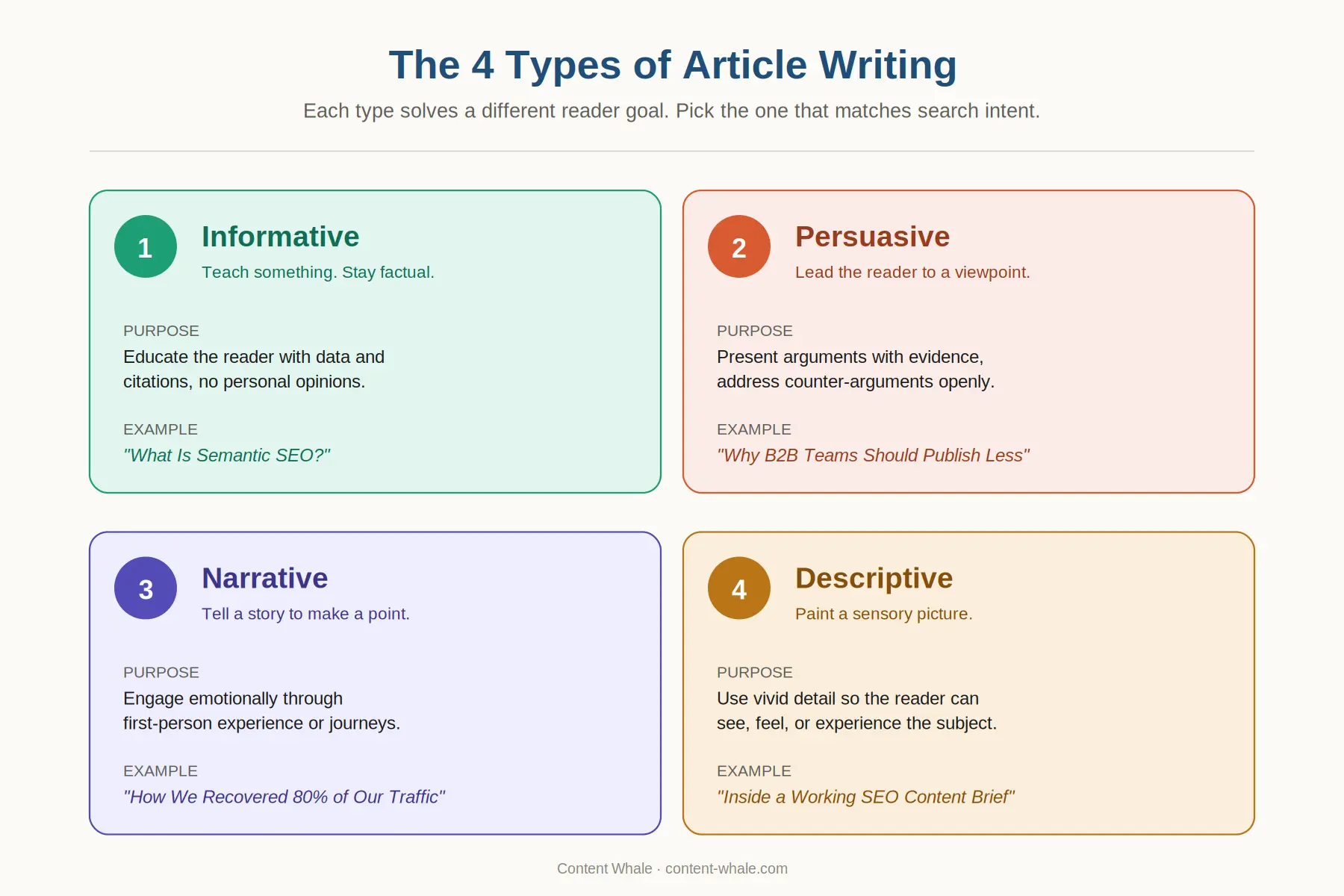
There are four primary types of article writing: informative, persuasive, narrative, and descriptive. Each type solves a different reader goal.
1. Informative articles
Informative articles teach something. They stay factual, cite data, and keep the writer’s opinions out. “What Is Semantic SEO?” or “A Beginner’s Guide to Container Gardening” are textbook informative pieces. This type dominates SEO because it maps cleanly to how-to and question-based search queries.
2. Persuasive articles
Persuasive articles lead the reader to a specific viewpoint or action. They present arguments with evidence and address counter-arguments openly. “Why Every B2B Team Should Publish Original Research” is persuasive writing. It takes a clear position and defends it with data, not feelings.
3. Narrative articles
Narrative article writing tells a story, usually first-person, to make a point land emotionally. Founder journeys, recovery case studies, and feature stories fall here. Narrative works hardest on brand blogs where the author’s experience is the product being sold.
4. Descriptive articles
Descriptive articles paint a sensory picture. Travel features, product reviews, and long-form profiles rely on this style. The goal is for the reader to see, taste, or feel what the writer is describing.
Other formats worth knowing
Beyond the core four, these article formats appear most frequently on the modern web, per Orbit Media’s 2025 Blogger Survey:
- How-to articles, used by 76% of surveyed bloggers
- Listicles, 54% of bloggers
- Reviews and comparison pieces
- Case studies
- News reports
- Opinion or editorial pieces
What Is the Article Writing Format?
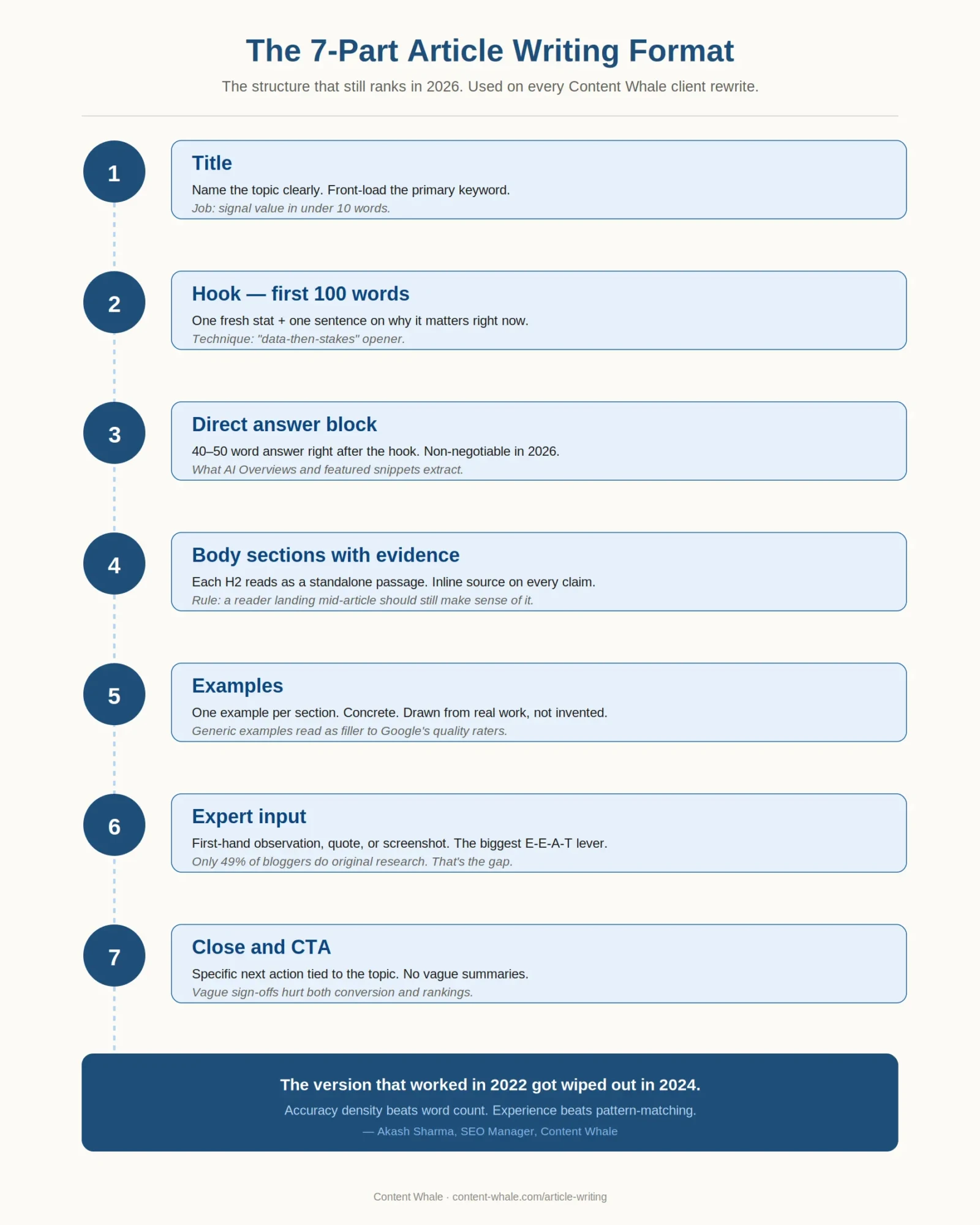
The standard article writing format has seven parts. Over the last five years, I’ve audited hundreds of client blogs, and the ones that still rank in 2026 respect all seven.
1. Title
A working title does three jobs: it names the topic clearly, front-loads the primary keyword, and signals value. “What Is Article Writing?” beats “Thoughts on Writing Articles Today” in every SERP test I’ve run.
2. Hook (first 100 words)
The opening paragraph has to do in 100 words what a landing page headline does in 10. Prove relevance. I use a “data-then-stakes” hook: one fresh statistic, one sentence about why it matters right now.
3. Direct answer block
After the hook, insert a 40 to 50 word direct answer to the headline question. Google’s AI Overviews and featured snippets extract this block. It is a 2026 non-negotiable.
4. Body sections with evidence
Each H2 should read as a self-contained block. If a reader lands on it from a search result, it should make sense without the rest of the article. Every factual claim gets an inline source citation.
5. Examples
One example per section, concrete and specific, ideally drawn from real work. Generic examples like “invest in solar power” read as filler to Google’s quality raters and bore readers.
6. Expert input
A quote from a practitioner, a screenshot of a live dashboard, or a first-person observation. This is the single biggest E-E-A-T lever, and the one most underused. Only 49% of bloggers ran original research in the past 12 months, per Orbit Media’s 2025 survey, which makes it the widest content gap to exploit.
7. Close and CTA
Stop summarising. Close with a specific next action the reader can take, tied to the article’s topic. Vague sign-offs hurt conversion and rankings alike.
How Do You Write an Article That Ranks in 2026?
To write an article that ranks in 2026, start with a specific search intent, write a 40 to 50 word direct answer near the top, structure sections as standalone passages, cite four to six recent sources, add first-hand experience, and match the format the SERP already rewards.
Step 1: Pick a topic tied to real search intent.
Do not pick “article writing” because it sounds useful. Check the SERP first. If the top 10 results are dominated by how-to content, a pure definition explainer will not fit.
Step 2: Run a content gap review.
Look at the top 10 ranking pages. List every H2. Your article needs to cover everything the top 3 cover, plus one angle none of them cover. That one extra angle is what ranks you.
Step 3: Build an outline around questions, not topics.
Question-based H2s win more featured snippets and AI Overview citations. “What is the article writing format?” beats “Article Writing Format.”
Step 4: Write the direct answer first.
Not the intro. The 40 to 50-word answer that will be extracted. Lock it in, then write the rest of the article around it.
Step 5: Cite as you write, never after.
Every data claim gets a link at the end of the sentence. If you cannot find a source within the last 24 months, either cut the claim or find fresh data.
Step 6: Add experience.
One paragraph of what you have seen in your own work. What you tested. What failed. Google’s December 2025 update tracks this kind of first-hand input through author citation patterns and cross-site signals (DEV Community practitioner analysis, December 2025).
Step 7: Edit for scannability, then for density.
Short paragraphs. Bullets where lists help. Cut any sentence that does not add a fact, an example, or a step.
Article Writing Examples
Here is what good looks like, broken out by type, so you can see how each style performs in practice.
Informative: “What Is First-Party Data?” is a factual explainer with definitions, legal context, and examples of how brands collect it. Source-heavy, zero opinion.
Persuasive: “Why Content Teams Should Publish Less, Not More” takes a clear position, backs it with publishing frequency data from Orbit Media, and addresses the counter-argument that volume still works.
Narrative: “How We Recovered 80% of Lost Traffic After the March 2024 Core Update” is first-person, timeline-based, with a mistake-and-fix structure.
Descriptive: “Inside a Working SEO Content Brief” walks through the actual template field by field, so the reader can picture the workflow.
Concrete examples drawn from real projects outperform invented ones in both rankings and conversions. If you want more article writing examples, Content Whale publishes live client samples on our samples page.
Tools Worth Using for Article Writing
I’ll keep this short because most “best tools” lists are affiliate pages. Here is what’s worth opening every week and what each one solves.
- Grammarly or ProWritingAid for grammar and clarity. Use one, not both.
- Copyscape or Originality.ai for plagiarism and AI-content detection. Essential if you work with freelancers.
- Semrush, Ahrefs, or Google Keyword Planner for keyword research and SERP review. Semrush is strongest for content gap analysis.
- AnswerSocrates and AlsoAsked for People Also Ask queries. Free and fast. If you wish to learn how to use these tools, read our keyword research guide.
- WordPress, still the CMS behind 61.1% of B2B blogs, per Backlinko’s 2025 analysis of 502 companies. Everything else is a distant second.
- Zotero for citation management if you write research-heavy pieces.
You do not need a 20-tool stack. You need four you actually use.
How Much Can You Earn From Article Writing in 2026?
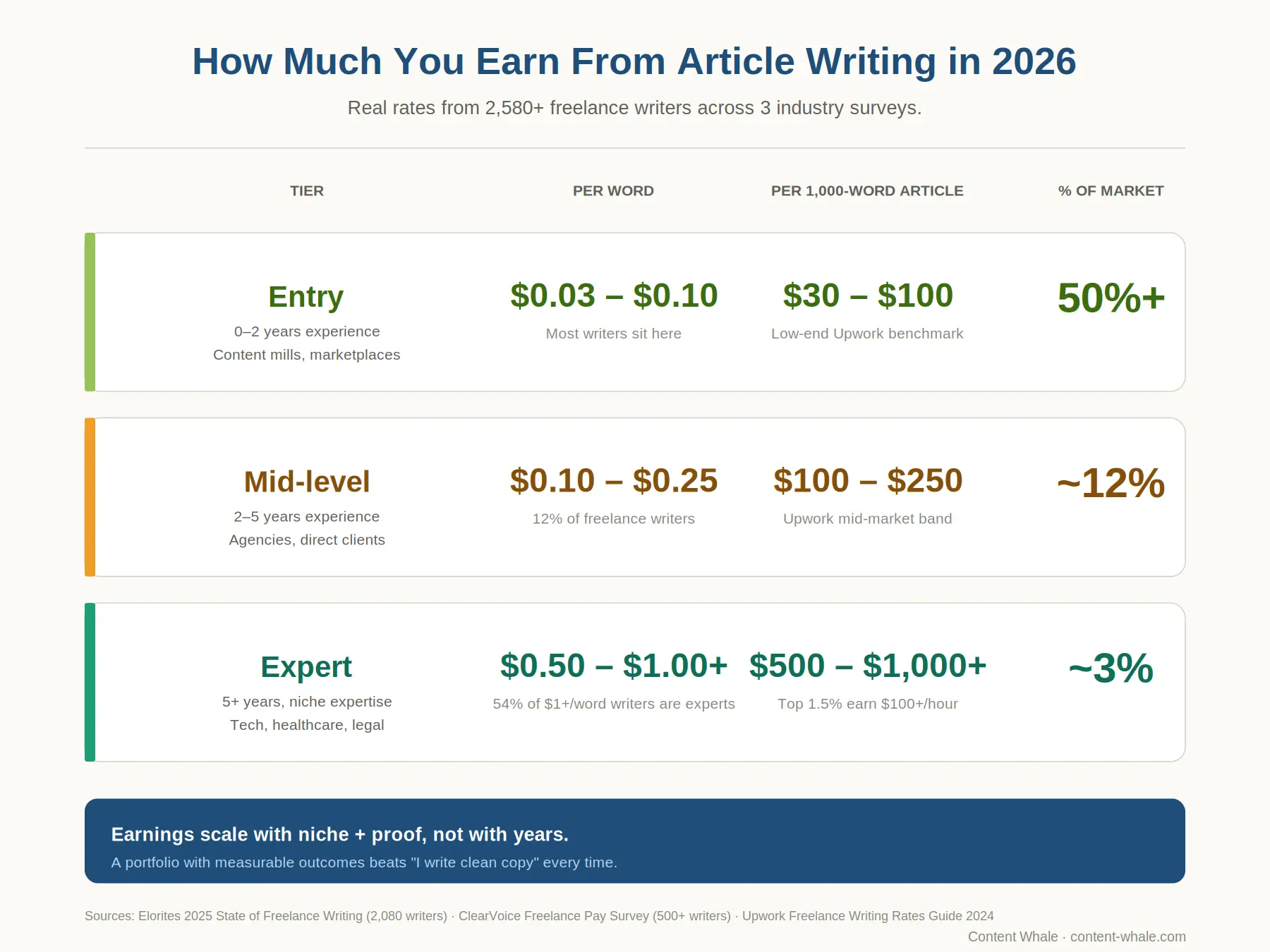
Freelance article writers in 2025 charged between $0.03 and $1.00 per word. Entry writers earned $0.05 to $0.10, mid-level writers $0.10 to $0.25, and experts $0.50 to $1.00 and above. A typical 1,000-word SEO article pays $100 to $300 at mid-market level, per Upwork’s 2024 benchmark.
Real numbers from recent industry surveys:
- More than 50% of freelance writers earn less than $0.10 per word, per Elorites’ 2025 global survey of 2,080 writers.
- The top 1.5% of freelance writers earn $100 or more per hour, per the same survey.
- A ClearVoice survey of 500+ writers found that 54% of writers charging $1 or more per word had expert-level experience, versus 5% of beginners.
- Upwork’s freelance writing rates guide puts a 1,000-word SEO article at $100 to $300 and above, depending on writer experience.
Earnings scale with niche and proof. Tech, healthcare, and legal article writing consistently pays the most. A portfolio of article writing examples with measurable outcomes beats a generic “I write clean copy” pitch every time.
Common Article Writing Mistakes That Kill Rankings
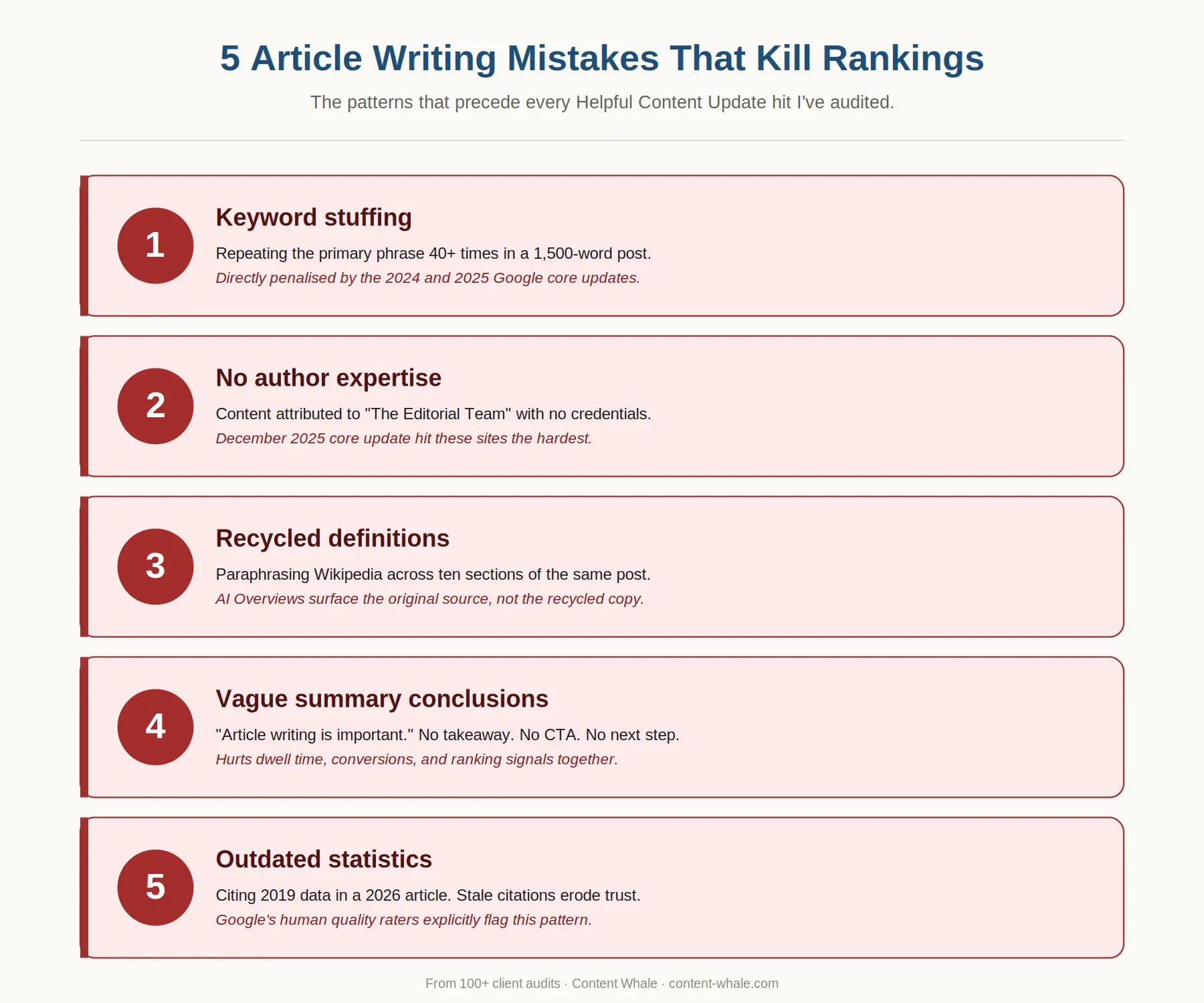
From my own client audits at Content Whale, these five patterns precede almost every Helpful Content Update hit.
- Keyword stuffing. Repeating the primary phrase 40 or more times in a 1,500-word post. The 2024 and 2025 updates specifically penalise this pattern.
- No author expertise. Content attributed to “The Editorial Team” with no credentials. The December 2025 update hit these sites hardest.
- Recycled definitions. Paraphrasing Wikipedia across ten sections. AI Overviews surface the original source, not the recycled version.
- Vague summary conclusions. “In closing, article writing is important.” No specific takeaway, no CTA, nothing the reader can act on.
- Outdated statistics. Citing 2019 data in a 2026 post. Google’s quality raters explicitly flag stale data as a trust signal.
Fixing these five is usually 80% of any content audit I run.
FAQs About Article Writing
What is article writing in simple terms?
Article writing is the process of creating structured, factual content on a specific topic, meant for publication in newspapers, magazines, or websites, to inform or persuade a defined audience.
What is the difference between article writing and blogging?
Article writing is typically third-person, factual, and topic-focused. Blogging is often first-person, personal, and serialised. Modern web articles borrow from both, which is why the line between them has blurred.
How long should an article be in 2026?
Length should match search intent. Orbit Media’s 2025 survey found the average blog post is 1,333 words, yet posts over 2,000 words earn up to 3x more backlinks, per Backlinko. Aim for the length the top-ranking SERP results already reward, not a generic target.
Can I write an article without being a subject-matter expert?
Yes, if you partner with one. Google’s December 2025 update rewards demonstrable experience over job titles. Interview a practitioner, quote primary research, and credit the expert openly. That combination often outperforms an in-house expert writing alone.
How do I start getting paid to write articles?
Start with a niche you understand, build three to five article writing examples with measurable outcomes, pitch directly to target publications or agencies, and set per-word rates based on your research depth. Upwork and Contra are useful entry points.
Which tools are essential for article writing today?
Four cover 90% of the job: a grammar checker (Grammarly), a keyword research tool (Semrush or Ahrefs), a question-research tool (AnswerSocrates), and a plagiarism checker (Copyscape or Originality.ai).
Ready to Rebuild Your Article Writing for 2026?
Article writing in 2026 rewards specificity and punishes padding. If your existing content has lost ground in recent Google updates, the fix is rarely a style rewrite. It is almost always a rebuild around direct answers, original evidence, and demonstrable author experience.
If you would rather let a team handle that rebuild, that is exactly the work we do at Content Whale. We run content audits, identify the passages Google is ignoring, and rewrite articles to match what actually ranks today. Talk to us about your site if your traffic has dropped and you want to know which fixes to prioritise first.